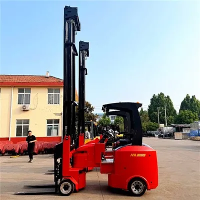
A VNA forklift aisle width cannot be selected from one advertised minimum. Start with the stacking-aisle value published for the exact truck and pallet format, then verify pallet entry direction, the actual load envelope, rack and protector clearance, the articulated truck's full sweep, the cross aisle, floor condition and lift configuration. Xinghao's current data illustrates the difference: the 2.5-ton model lists about 2,000 or 2,200 mm, while the 3-ton model lists about 2,200 or 2,400 mm, depending on the named pallet format. These are planning references, not universal safe-width guarantees.
What "Aisle Width" Must Mean on Your Drawing
A warehouse drawing can contain several widths that sound similar but answer different questions. Mixing them is one of the fastest ways to approve a truck that cannot complete the real pallet movement.
Clear rack-to-rack width
The horizontal distance between the nearest permanent rack faces. Measure the narrowest point, including columns, bracing, guards and other fixed projections.
Clear pallet-to-pallet width
The free space between the real stored loads. Pallet or carton overhang can make this smaller than the rack-to-rack dimension.
Stacking aisle, Ast
The working width needed for a specified truck to turn or articulate, align the load and place or retrieve the stated pallet under defined conditions.
Published Aisle Data for Xinghao 2.5 and 3 Ton VNA Models
Xinghao's current product pages provide four useful reference points. The 2.5 ton VNA forklift lists approximately 2,000 mm for an 800×1200 mm pallet and 2,200 mm for a 1000×1200 mm pallet. The 3 ton VNA forklift lists approximately 2,200 and 2,400 mm for those formats.
| VNA model | Rated load | Published pallet format | Published stacking aisle | How to use the figure |
|---|---|---|---|---|
| 2.5 ton articulated VNA | 2,500 kg | 800×1200 mm | Approx. 2,000 mm | Baseline for this stated model and pallet only |
| 2.5 ton articulated VNA | 2,500 kg | 1000×1200 mm | Approx. 2,200 mm | Recheck entry side and actual load envelope |
| 3 ton articulated VNA | 3,000 kg | 800×1200 mm | Approx. 2,200 mm | Do not substitute the 2.5-ton aisle figure |
| 3 ton articulated VNA | 3,000 kg | 1000×1200 mm | Approx. 2,400 mm | Verify rack, load and site clearances |
The values above reproduce the approximate figures currently published on the linked Xinghao model pages. They do not state the allowance already built into every possible warehouse layout.

800×1200 vs 1000×1200 Pallets: Orientation Changes the Envelope
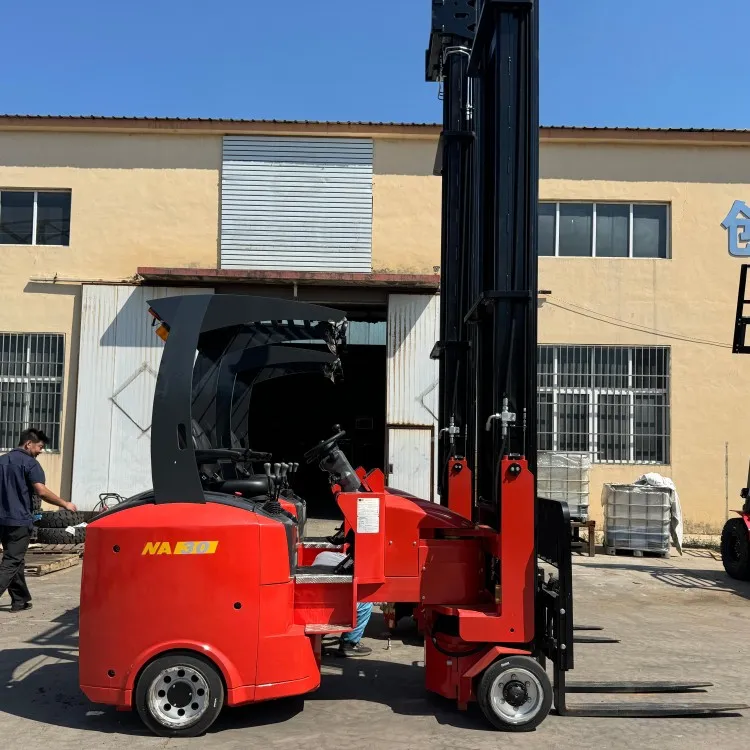
The notation "800×1200" describes a footprint, but it does not by itself show which side faces the aisle or which side the forks enter. That orientation changes the load length along the forks and the width that sweeps across the aisle.
When the forks enter the shorter face
For an 800×1200 mm pallet, fork entry through the 800 mm face puts the 1200 mm dimension along the forks. The load projects farther in front of the fork face during articulation.
For a 1000×1200 mm pallet, entry through the 1000 mm face also places 1200 mm along the forks, but the aisle-facing load width is larger.
When the forks enter the longer face
Entry through the 1200 mm face shortens the dimension along the forks to 800 or 1000 mm, while the 1200 mm side becomes the transverse load width.
This may change both the articulation envelope and the rack opening required for placement. The rack design must support the selected entry direction.
Measure the cargo, not only the timber or plastic pallet. Stretch wrap, cartons, drums and irregular goods can extend beyond the deck. Use maximum loaded length, maximum loaded width and the real center of gravity when requesting an aisle review.
Rack Clearance Is More Than the Space Between Uprights
A rack drawing should show the load in its stored position and the truck during approach. The critical clearance can be at a rack protector near floor level, at an overhanging pallet, at the fork tips, at the articulated front frame or at the rear body as the operator aligns the load.
- Rack upright and beam locations
- End-of-aisle column guards
- Pallet and product overhang
- Fork length and fork spread
- Lowest beam and free-lift needs
- Highest pallet and roof clearance
- Sprinklers, lights and suspended services
- Damaged or leaning loads in normal use
Do not silently add one generic clearance to every value. First ask what the manufacturer's published stacking-aisle number already includes, then add only the site-specific allowance that is missing. Double-counting creates wasted space; omitting a clearance creates contact risk.
Articulation Geometry and Turning Space Must Be Checked Separately
An articulated VNA forklift does not behave like a conventional counterbalance truck. Its front section rotates toward the rack while the rear chassis remains largely aligned with the aisle. The planning envelope therefore includes the fork-tip path, pallet corners, front-frame sweep, articulation joint and rear body-not only a circular turning radius.
The 3-ton Xinghao page publishes a 210-degree articulation angle, but that angle alone cannot calculate the required aisle. Overall dimensions, fork length, pallet dimensions, load overhang and steering geometry still define the real sweep.
The end-of-aisle cross corridor is a second calculation. A truck may stack successfully inside the rack aisle yet lack room to enter from the transfer aisle, pass an end protector, turn through a doorway or align at a pickup-and-deposit location. Draw these movements as separate paths.

Floor Condition Changes How Much Usable Clearance You Have
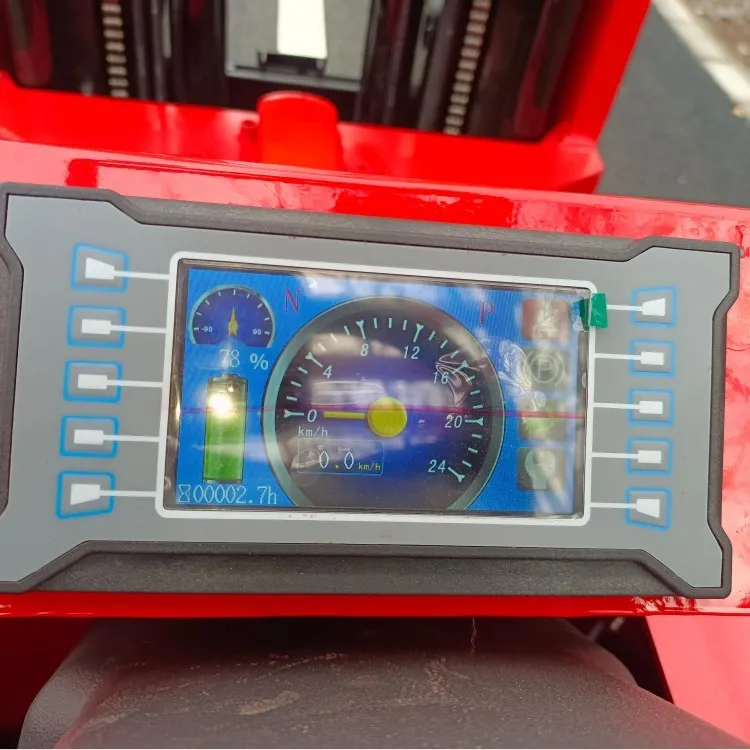
A dimension that works on a clean drawing can fail on an uneven floor. Joints, local settlement, slopes, drainage channels and debris change the truck's position relative to the rack. The effect becomes more important as the mast rises because small movements at wheel level can translate into greater displacement higher up.
Do not assume every articulated VNA application requires the same floor specification. The required flatness and levelness depend on the selected truck, travel and lift height, guidance arrangement, speed controls, rack tolerance and local operating rules. Survey the actual route and ask the supplier to state the floor requirement for the quoted configuration.
Inspect along the complete route
Check the dock, transfer corridor, aisle entrance and full rack run. Record cracks, abrupt joints, gradients, thresholds and the narrowest fixed obstruction.
Validate at the real lift condition
Review the highest pallet level, residual capacity and mast behavior. A low-level turning demonstration does not confirm high-level rack placement.
A Practical VNA Aisle Measurement Workflow
Map every critical width
Measure clear rack-to-rack width, pallet-to-pallet width, aisle entrance, cross aisle, doors, gates and any column pinch point. Use the smallest repeated and isolated values.
Define every pallet format
List pallet deck size, permitted entry sides, maximum loaded length and width, load overhang, maximum weight and load center. Include exceptional loads, not just the most common pallet.
Overlay the rack geometry
Add uprights, beam heights, protectors, rack depth, lowest beam, top pallet level, roof steel, sprinklers and other overhead limits.
Select the exact truck class
Compare the published stacking-aisle data for the exact capacity and pallet format. Review the VNA articulated forklift range before fixing one model.
Check stacking and transfer paths
Test entry, articulation, pallet pickup, rack placement, exit and end-of-aisle turning. Include the rear body and load corner sweep.
Confirm with a documented trial
Freeze rack installation or equipment purchase only after the final model, mast, forks, attachment, pallet orientation and site allowance have been reviewed together.
Choose Capacity and Aisle Width as One Decision
Do not choose the narrowest truck first and check load capacity later. The maximum pallet weight, load center and residual capacity at the highest rack level decide which capacity class is suitable. The comparison table shows that the 3-ton model's published aisle is about 200 mm wider than the 2.5-ton model for each listed pallet format; that difference is specific to these published configurations and should not be turned into a universal rule.
If pallet loads remain within the lighter class, compare the 2 ton VNA forklift as well. If the available warehouse aisle is wider and the operating method favors a conventional reach mechanism, review electric reach trucks before finalizing the rack layout.
VNA Forklift Aisle Width Questions
What is the minimum aisle width for a VNA forklift?
There is no single minimum for every VNA forklift. Use the stacking-aisle value for the exact truck, pallet format and orientation, then verify the actual load envelope, rack clearance, floor, mast and transfer path.
Is a 1.8 m aisle wide enough for an articulated forklift?
It may fit some configurations, but it is not a general Xinghao VNA claim. Current published values for the 2.5-ton and 3-ton models in this guide range from approximately 2.0 to 2.4 m depending on model and pallet format.
Why does pallet orientation affect VNA aisle width?
Orientation determines the load length along the forks and the transverse width that sweeps through the aisle. It also changes the rack opening and fork-entry arrangement required for placement.
Should I measure rack-to-rack or pallet-to-pallet width?
Measure both. Rack-to-rack width identifies fixed geometry, while pallet-to-pallet width captures overhang and real stored loads. Use the smaller effective clearance at each location.
Can I use the 2.5-ton aisle figure for a 3-ton VNA truck?
No. The current model pages publish different aisle figures. Check the exact truck, capacity, mast, forks, pallet and load instead of transferring one model's number to another.
What information is needed for a VNA aisle review?
Send the rack drawing, clear widths, pallet sizes and entry sides, maximum loaded dimensions and weight, rack heights, top pallet level, protectors, cross aisle, floor conditions, shift pattern and destination country.
Send the Rack Drawing Before You Freeze the Aisle
We can compare the 2.5-ton and 3-ton VNA configurations against your real pallet and rack layout. Send clear rack-to-rack and pallet-to-pallet widths, pallet entry direction, maximum loaded dimensions and weight, beam heights, top pallet level, aisle entrance, cross aisle and floor notes. We will use those inputs to review the appropriate model and identify the dimensions that still require site confirmation.
Send Rack Drawing + Pallet Dimensions