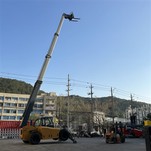
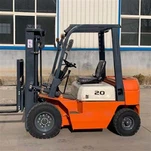
Choosing between a telescopic handler and a masted rough terrain forklift comes down to a strict calculation of Capex and load statics. Unless a project requires horizontal forward reach over physical obstacles, deploying a 5 ton 4WD forklift provides identical heavy-lifting capabilities in deep mud at a fraction of the manufacturing and maintenance cost.
Vertical Lift vs. Forward Reach: The Structural Difference
Evaluating a rough terrain forklift vs telehandler begins with the statics of load handling. A masted forklift operates on strict vertical lift mechanics, keeping the Load Center close to the drive axle to maximize mechanical stability and traction. Conversely, a telehandler utilizes a boom architecture that shifts the center of gravity forward dynamically as the boom extends. While this forward reach is mandatory for placing materials over trenches or scaffolding, it introduces severe torsional stress. For standard material transfer on muddy ground, the vertical mast physically forces the weight down onto the drive axle, maximizing raw mechanical grip without relying on complex electronic load moment indicators.
Capital Expenditure (Capex): Why Masted Forklifts Win on Price
The financial reality of fleet procurement heavily favors the masted counterbalance chassis. Telehandlers require complex hydraulic compensation cylinders, advanced boom fabrication, and electronic overload sensors to manage dynamic tipping points. This engineering complexity directly inflates the initial Capex. A 5-ton capacity masted rough terrain forklift strips away this electronic and hydraulic overhead. By relying on a straightforward thickened box-section steel mast and heavy cast-iron rear counterweights, the manufacturing cost is significantly reduced. Fleet managers secure the same lifting capability and 4WD muddy terrain performance while accelerating their ROI.
Maintenance Simplicity of Chain-Driven Masts in Mud
Operating in unpaved construction sites or agricultural fields immerses the equipment in mud, abrasive sand, and water. Telehandlers feature enclosed boom sections with internal wear pads and hidden hydraulic lines; when abrasive slurry penetrates these sections, it accelerates friction wear and spikes maintenance Opex. In contrast, a masted forklift utilizes an exposed chain-driven lifting mechanism. When the shift ends, maintenance crews simply utilize high-pressure water to wash the mud off the exposed mast rollers, chains, and carriage. This mechanical simplicity guarantees higher uptime and eliminates the need for specialized boom teardowns during routine servicing.
| Specification | 5-Ton Masted 4WD Forklift | 5-Ton Telehandler (14m Reach) | Procurement Impact (TCO) |
| Load Center Dynamics | Fixed vertical lift | Variable forward reach | Masted unit offers superior mechanical stability during heavy ground transport |
| Chassis Complexity | Simple counterbalance | Hydraulic boom compensation | Significantly lower Capex for masted units |
| Maintenance Access | Exposed chains and rollers | Internal boom wear pads | Masted unit allows fast high-pressure washing; lowers Opex |
| Traction Hardware | Limited Slip Differentials | 4-Wheel Steering & Crab Walk | Both handle deep mud, but masted axles cost less to maintain |
| Fleet ROI | Low initial Capex, fast recovery | High Capex | Masted forklift dominates for pure vertical material transfer |


Frequently Asked Questions (FAQ)
Q: When should I procure a telehandler over a masted rough terrain forklift?
A: Procure a telehandler only when the project dictates horizontal forward reach, such as placing loads over open trenches or onto upper scaffolding levels. If the operation exclusively requires lifting and transferring heavy pallets across muddy terrain, a masted rough terrain forklift offers a far superior ROI.
Q: Does a 5-ton 4WD forklift maintain sufficient traction in deep mud?
A: Yes. The unit utilizes wide off-road pneumatic tires, Limited Slip Differentials, and enclosed Wet-Disc Brakes. The vertical mast concentrates the payload weight directly over the front drive axle, mechanically forcing maximum grip and preventing wheel slip in harsh environments.
Q: How do maintenance costs compare between the two machines?
A: The masted forklift drastically lowers maintenance Opex. Its exposed chain-and-roller mast can be cleaned instantly with high-pressure water, whereas a telehandler's enclosed boom traps abrasive mud and requires expensive, specialized servicing for internal wear pads and complex hydraulic lines.
Contact our heavy machinery export team today to receive a complete TCO calculation sheet comparing the Xinghao 5-ton 4WD forklift with equivalent telehandler models. Request our factory-direct bulk procurement pricing to immediately optimize your fleet Capex.