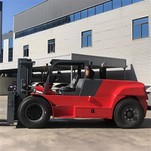
Environmental emission regulations are forcing heavy industries to transition their fleets, but procurement directors hold a legitimate physical skepticism: can a battery-powered piece of equipment actually output the mechanical traction and breakout force of a large-displacement diesel engine? When your site demands lifting 16,000 kg of steel coils or precast concrete over unpaved yards during a 10-hour shift, paper specifications mean nothing. This guide strips away the environmental marketing to analyze the raw physics of electric drivetrains, thermal battery management, and the exact Total Cost of Ownership (TCO) math required to justify replacing your heavy diesel fleet with a 16 ton electric forklift.
Matching Diesel Mechanical Torque with Dual Drive Motors
Heavy equipment operators are accustomed to the low-RPM torque curve of a Cummins or Weichai diesel block. The primary operational fear when transitioning to electric power is stalling under maximum load on a gradient. To physically counter this, professional-grade electric chassis do not rely on a single oversized motor. Instead, they utilize a dual-drive AC asynchronous motor architecture integrated directly into the heavy-duty drive axle.
By routing the electrical power through a specialized planetary reduction gearbox, the high-speed rotation of the electric motors is physically converted into massive, instantaneous wheel torque. Unlike a diesel engine that must rev up to overcome a torque converter's fluid coupling, electric motors deliver 100% of their rated torque from 0 RPM. This physical characteristic guarantees zero rollback on steep ramps and provides absolute static control when inching 16-ton payloads into tight staging positions.
The 5-Year Capex vs. Opex Mathematical Breakdown
Procuring a heavy duty lithium forklift demands a significantly higher initial Capital Expenditure (Capex), primarily due to the material cost of the high-density CATL battery pack. However, fleet procurement must be calculated over a 5-year Operational Expenditure (Opex) lifecycle.
Consider the mathematics of heavy operation: A 16-ton diesel forklift burning 8 to 12 liters of diesel per hour over a standard 2,000-hour annual shift will consume between 16,000 and 24,000 liters of fuel a year. In contrast, an electric equivalent consumes roughly 15 to 20 kWh per operating hour. By charging the high-voltage lithium pack during off-peak industrial electricity rates, fleet managers typically reduce direct energy costs by 60% to 75%.
Furthermore, removing the internal combustion engine physically eliminates the need for transmission fluid changes, oil filters, piston ring replacements, and Diesel Particulate Filter (DPF) servicing. When you factor in the heavily reduced electric forklift maintenance requirements, the break-even point for the initial Capex premium typically occurs between month 18 and 24 of heavy, multi-shift operation.
LFP Battery Chemistry and Thermal Management
A common hesitation among fleet buyers is battery degradation under heavy industrial loads. To ensure structural longevity, our equipment utilizes Lithium Iron Phosphate (LFP) cell chemistry sourced directly from CATL. Unlike consumer-grade lithium-ion batteries, LFP cells are physically engineered to withstand extreme charge and discharge cycles without risking thermal runaway.
When a machine lifts 16 tons repeatedly, massive amperage is drawn from the pack, generating heat. To prevent thermal throttling, these heavy-duty battery packs are encased in high-strength steel housings and governed by an active liquid thermal management system. This ensures the cells remain within their optimal temperature window, allowing the pack to retain over 80% of its original capacity even after 4,000 deep charge cycles.
Our products

Eliminating Exhaust Heat in Indoor Steel Warehouses
Beyond direct fuel savings, transitioning away from diesel removes a massive hidden cost in indoor heavy manufacturing. Moving 16-ton steel coils, paper rolls, or industrial molds inside enclosed facilities forces HVAC systems to work continuously to extract toxic diesel particulate matter (DPM) and heavy exhaust heat.
A large-displacement diesel engine acts as a massive thermal radiator, raising the ambient temperature of the warehouse and drastically increasing cooling costs during summer months. An electric drivetrain operates with zero localized emissions and minimal thermal output. This physical reduction in indoor heat generation allows facility managers to downgrade their ventilation cycles, directly translating into secondary electrical savings for the entire plant.
Critical Technical Specifications
- Rated Load Capacity: 16,000 kg
- Battery Architecture: CATL Lithium Iron Phosphate (LFP)
- System Voltage: 614V High-Voltage Platform
- Drive System: Dual AC Drive Motors with Planetary Gearbox
- Braking System: Maintenance-free Wet Multi-Disc Brakes
- Thermal Management: Active Liquid Cooling System
Stop burning your operational budget on diesel and mechanical downtime. Input your daily operating hours and local industrial energy rates into our portal, or contact our engineering team directly to receive a customized heavy forklift diesel-to-electric Return on Investment (ROI) calculation sheet.