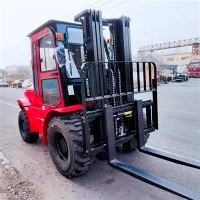
Walk onto any major infrastructure project in Europe or North America, and you rarely see standard outdoor counterbalance trucks. The default machine on site is now a 14m telehandler. Modern construction sites present complex, three-dimensional logistical challenges that render older equipment obsolete. Whether moving heavy steel scaffolding across deep muddy trenches, or delivering pallets of cement blocks precisely to a fourth-story working deck, a traditional construction forklift simply lacks the vertical lift, forward reach, and physical stability required. Telescopic handlers serve as the central operational hub of the site, combining the high-altitude capabilities of a compact crane, the pushing force of a wheel loader, and the heavy material handling capacity of an industrial forklift into a single, highly maneuverable chassis.
Reaching the 4th Story: Load Capacity vs. Height
When procuring high-reach equipment, fleet managers often make the critical mistake of looking only at the maximum rated capacity on the brochure. In physical engineering, leverage and the fulcrum point dictate reality. As the telescopic boom extends upward and forward to 14 meters (approximately four stories), the load's center of gravity shifts dramatically away from the front axle. This physical shift causes the residual lifting capacity to drop exponentially.
Proper procurement requires a deep understanding of the machine's specific load chart. A well-engineered 14m telehandler relies on a high-density cast rear counterweight, an extended wheelbase, and a wide track stance to maintain safe lifting capacities at both maximum height and maximum forward reach. This structural rigidity is non-negotiable; it prevents catastrophic metal deflection in the boom channels and eliminates the risk of forward tipping when placing heavy building materials at extreme altitudes.
Hydraulic Precision and Safety Systems
Lifting a load to 14 meters is only half the equation; placing it without damaging the structure requires extreme hydraulic precision. Standard open-loop gear pumps cause mast stutter, which translates to violent, pendulum-like swinging at the top of a fully extended boom.
Professional-grade machines utilize closed hydraulic systems with variable displacement piston pumps. This ensures smooth, millimeter-level control over the boom extension and retraction, regardless of the engine's RPM. Furthermore, modern units integrate factory-calibrated torque limiting systems. This onboard computer constantly monitors the boom angle, extension length, and payload weight, automatically locking out dangerous hydraulic functions before the machine exceeds its safe operational envelope.
Four-Wheel Drive for Unpaved Construction Sites
Major building projects do not feature paved warehouse floors. During early and mid-phase construction, the terrain consists of deep mud ruts, loose gravel, steep gradients, and scattered demolition debris. An effective outdoor construction forklift requires significant ground clearance (often exceeding 400mm) and a permanent four-wheel-drive (4WD) drivetrain.
To overcome these harsh site conditions, heavy-duty telescopic chassis utilize deep-tread pneumatic tires mounted on heavy-duty wet brake axles. These sealed braking systems prevent mud and grit from destroying the internal components. Coupled with three distinct steering modes-front-wheel, four-wheel, and crab steering-operators maintain traction in half a meter of mud. Crab steering specifically allows the machine to move diagonally, perfectly aligning parallel to scaffolding or exterior walls for efficient unloading in highly restricted spaces without complex, dangerous reversing maneuvers.
Wholesale Sourcing for Equipment Rental Fleets
For equipment rental companies and large construction firms, expanding the fleet is driven by one primary metric: a rapid return on investment (ROI). Sourcing European or American brand equipment through regional dealerships introduces massive retail markups that artificially inflate your capital expenditure and delay your break-even point.
By purchasing directly from manufacturing assembly lines in China, rental fleets bypass these distributor margins entirely. We provide authentic factory-direct pricing, allowing you to acquire a highly versatile telescopic handler for the budget of a standard outdoor rough terrain forklift. Beyond the initial purchase price, direct OEM sourcing guarantees immediate access to replacement parts and technical schematics, drastically reducing maintenance downtime. This comprehensive capital advantage translates directly into highly competitive bidding rates for your next major infrastructure contract.
Stop paying unnecessary brand premiums for heavy machinery. Get the wholesale price, detailed load charts, and OEM customization options for a 14m telehandler today, and let our engineering team structure a direct procurement plan for your fleet.