Where a 5 Ton Rough Terrain Forklift Fits
A 5 ton rough terrain forklift is a mast-equipped counterbalance truck for moving heavy palletized loads where the travel route is unpaved, rutted, loose or seasonally muddy. This model combines a published 5,000 kg rated capacity with a 4WD drivetrain and deep-tread pneumatic tyres. It is intended for buyers who need vertical forklift handling outdoors, rather than the forward reach of a telescopic handler.
Capacity alone does not confirm job suitability. Before ordering, match the truck to the actual load center, lift height, attachment, gradient, surface condition and travel clearance. The quotation and load documentation should record the selected configuration.
Published capacity5,000 kg
Drive layout4WD / 4×4
Listed lift height3,000 mm standard
Travel surfaceUnpaved outdoor yards
What the 4WD Layout Changes
A conventional warehouse forklift is normally selected for smooth, level paving. An outdoor truck must maintain traction and chassis clearance while the tyres cross loose aggregate, compacted soil and shallow ruts. The current unit carries visible 4WD identification and uses an off-road tyre pattern with larger voids than an indoor industrial tyre.
- Four-wheel drive: distributes drive effort through the 4×4 system when the route offers uneven grip.
- Front differential lock: is listed for the current product and should be verified in the final drive-axle specification.
- Oscillating axle arrangement: helps the tyres follow uneven ground; it does not remove the need for a level lifting position.
- Deep-tread pneumatic tyres: support outdoor traction, but tyre pattern and pressure still need to match the site.
4WD improves mobility; it does not make every slope or soft surface safe. The buyer should define the worst route, not only the normal route.

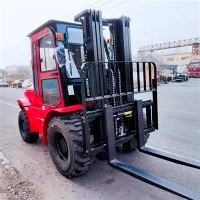
Open-canopy configuration showing the 4WD marking, tyre profile and high-clearance outdoor chassis.
Published Procurement Baseline
The table separates information already published for this product from details that should be frozen on the sales order. This prevents an engine, mast, cabin or attachment option from being treated as universal equipment.
| Selection point | Current published basis | What the buyer should confirm |
|---|---|---|
| Rated load | 5,000 kg / 5 tonnes | Rated load center, residual capacity at required height and capacity with the selected attachment |
| Drive system | 4WD / 4×4 | Axle specification, differential-lock operation and permitted travel gradients |
| Steering and axle | Hydraulic power steering with oscillating axle listed | Turning clearance, axle configuration and operating instructions for the selected unit |
| Transmission | Torque-converter powershift transmission listed | Gear arrangement, service-fluid specification and local parts requirements |
| Tyres | Deep-tread pneumatic rough-terrain tyres | Tyre size, tread pattern, pressure and suitability for mud, gravel, compacted soil or mixed surfaces |
| Lift system | 3,000 mm standard lift height listed | Mast type, lowered height, free lift, maximum lift height, fork size and load chart |
| Power source | Diesel configuration | Exact engine model, rated output, fuel quality and destination-market emissions requirement |
| Operator station | Open canopy and enclosed-cab units are shown | Canopy or cabin, heater or air conditioning, lighting, visibility equipment and required safeguards |

Current equipment image showing the FD50RT4 marking and a consistent 4WD fleet configuration.
Choose by the Load Route, Not Tonnes Alone
The rated load is only the starting point. A buyer handling stone crates, timber packs, construction materials or agricultural pallets should map the complete route from pickup to set-down. A truck that can lift the load may still be unsuitable if the aisle is too narrow, the mast cannot pass a doorway or the ground cannot support the combined truck and load.
- Record the maximum load weight, dimensions and actual load-center distance.
- Measure the required lift height and any overhead clearance restriction.
- Identify the steepest gradient and whether the truck travels loaded on it.
- Describe the surface in dry and wet seasons, including soft edges and drainage channels.
- State the narrowest passage, gate width and turning area.
- Name the attachment and hydraulic functions if standard forks are not sufficient.
Typical Outdoor Handling Decisions
Construction supply yards
Check aggregate depth, ramps, unfinished access roads and the need to place palletized materials near active work zones.
Stone and block handling
Confirm crate dimensions, load center, fork length and residual capacity instead of relying on gross material weight alone.
Timber operations
Define pack width, surface debris and whether a fork positioner, side shifter or dedicated handling attachment is required.
Agricultural sites
Account for seasonal mud, field-to-yard transitions, crop-row clearances and the actual pallet or bulk-handling method.
Equipment rental fleets
Standardize the engine, mast, cabin, tyre and service-parts list so multiple units share the same maintenance baseline.
Remote project sites
Plan filters, routine service items, manuals and commissioning information before the machine leaves the shipping point.
Send the Site Data Before Final Configuration
Provide the load weight and center, lift height, attachment, ground condition, maximum gradient, destination country and preferred operator-station configuration. The response can then focus on the correct operating envelope and quotation basis.
Request a Site-Fit ReviewForklift or Telehandler?
Both machine types can work outdoors, but they solve different placement problems. This mast forklift is the more direct choice when the load is collected and set down close to the front of the truck. A telehandler uses a telescopic boom when the project needs forward outreach, obstacle clearance or a substantially different lift geometry.
| Job question | Mast rough-terrain forklift | Telehandler |
|---|---|---|
| Primary movement | Vertical lifting and yard transport | Vertical lift plus forward outreach |
| Load position | Close to the mast and truck | Can be placed beyond obstacles |
| Buyer data | Load center, lift height, aisle and ground | Load chart point, outreach, height and stabilizing arrangement |
For boom-reach applications, compare the dedicated telehandler range. For mast-based outdoor trucks, review the full 4WD rough terrain forklift series.

Field image demonstrating the type of soft, uneven route that should be described during model selection.
Pre-Order Evidence and Delivery Checkpoints
Heavy equipment should be purchased against an agreed configuration record. Ask for evidence that matches the exact machine being quoted, rather than relying on a general product-family statement.
Freeze the specification
Record engine, transmission, axles, mast, forks, tyres, cabin, attachment and destination requirements.
Review the load basis
Check the load center and capacity at the required height and attachment configuration.
Request unit evidence
Agree on inspection photos or video, serial identification and functional checks for the ordered unit.
Confirm shipping scope
List any removed parts, packing arrangement, manuals, service items and reassembly responsibilities.

Multiple enclosed-cab units prepared for transport; final dimensions and dismantled items should be confirmed per order.
Configuration and Import Planning
The current product record shows both open and enclosed operator stations. It also lists multiple diesel-engine possibilities, so the engine identity must be confirmed rather than inferred from the product name. Buyers in North America, Europe and the Middle East should state their destination country and applicable engine or equipment requirements at the quotation stage.
For fleet orders, keep the selected specification consistent across units. A common filter list, tyre specification, mast arrangement and electrical setup makes parts planning easier. If local service teams will commission the truck, request the operating documentation and the final packing list before dispatch.
Additional support paths include after-sales and parts information, manuals and training, and the contact page.
Related Equipment and Site Resources
Frequently Asked Questions
Does the 5,000 kg rating apply in every terrain condition?
No single capacity figure describes every condition. Confirm the rated load center, required lift height, attachment, gradient and surface. Lifting should be evaluated against the load information for the ordered configuration and performed from an appropriate position.
How is this different from a standard 5 tonne diesel forklift?
The rough-terrain configuration is built around 4WD travel, outdoor tyre tread and an axle arrangement intended for uneven routes. A standard industrial forklift is normally the better fit for firm, smooth and level paved surfaces.
Should I choose this forklift or a telehandler?
Choose a mast rough-terrain forklift for vertical pallet handling and yard transport close to the truck. Consider a telehandler when the load must reach forward, clear an obstacle or follow a boom-specific placement path.
Which details are required for a useful quotation?
Send load weight and dimensions, load center, lift height, attachment, ground description, maximum gradient, travel clearances, destination country and preferred canopy or cabin. Photos or a simple site sketch can make the review more precise.
Can the engine, mast and operator station vary?
The current product information presents configuration choices and shows both open-canopy and enclosed-cab machines. Treat the exact engine, emissions setup, mast, fork, tyre and operator-station specification as order-specific until they appear on the quotation.
What should be checked before overseas dispatch?
Verify the final configuration record, machine identification, agreed inspection evidence, shipping dimensions, removed components, packing list, manuals and any service items included in the shipment.
Build the Quote Around Your Actual Route
Share the heaviest load, lift point, attachment and the worst ground condition on site. This information is more useful than a capacity request alone.
Get a Configuration-Based QuoteHot Tags: 5 ton rough terrain forklift, 5 tonne rough terrain forklift, 4WD rough terrain forklift, 5000 kg off road forklift, diesel rough terrain forklift, outdoor forklift truck, China rough terrain forklift supplier, 2 5 Ton Rough Terrain Forklift, 3 Ton Rough Terrain Forklift, 4WD 4 ton rough terrain forklift, how much of 2 5 ton rough terrain forklift, Rough Terrain Forklift 5 Tonne CPCD50, Rough Terrain Lift Trucks 4 0 tonne