

45 Ton Diesel Forklift for Oversized Industrial Loads
The Xinghao FD450 is published with a 45,000 kg rated capacity at a 1,250 mm load center. Current product data lists a 4 m two-stage mast, 2,400 mm forks, Weichai or Cummins diesel engines and a heavy fork-positioning configuration for large industrial cargo.
45 Tons Is Only Valid at the Specified Load Center
A 45,000 kg capacity label does not describe every possible cargo shape. The real center of gravity, fork-entry geometry, lift height and attachment determine whether the published 1,250 mm load-center condition matches the job.
Heavy Mast, Fork and Counterweight Configuration

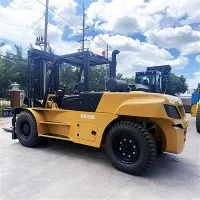
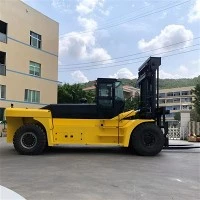
Side profile showing the long chassis, mast, cab and heavy rear counterweight.

Front-side view showing the fork carriage, mast structure and front tire stance.

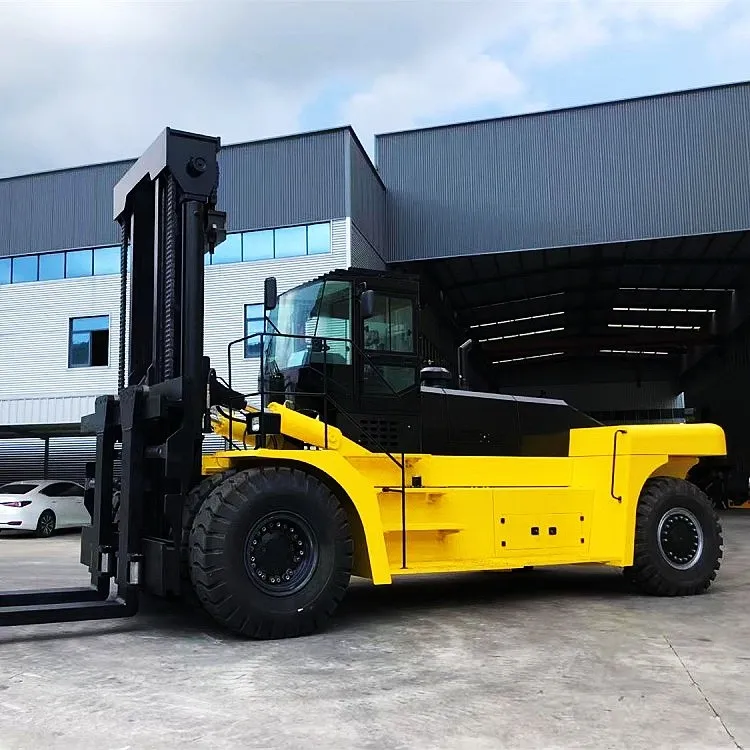
Front view provides a clear reference for mast width and heavy fork arrangement.
Core 45 Ton Forklift Specifications
| Parameter | FD450 Published Data | Buyer Check |
|---|---|---|
| Rated Capacity | 45,000 kg | Confirm against actual load geometry. |
| Load Center | 1,250 mm | Compare with actual center of gravity. |
| Lift Height | 4,000 mm current reference | Confirm required working height. |
| Fork Dimensions | 2400 × 320 × 120 mm | Check insertion depth and support points. |
| Overall Length | 9,760 mm | Include load projection in site review. |
| Overall Width | 3,360 mm | Check gates and working lanes. |
| Cab Height | 3,460 mm | Check overhead clearance. |
| Travel Speed | 25 / 28 km/h | Loaded / unloaded reference. |
| Lifting Speed | 260 / 280 mm/s | Loaded / unloaded reference. |
| Ground Clearance | 400 / 460 mm | Mast / wheelbase-center reference. |
| Transmission | 2 forward / 1 reverse | Confirm ordered drivetrain. |
| Tires | 14.00-24-32PR pneumatic | Confirm final front/rear setup. |
Match the 2.4 m Forks to the Cargo Support Points
Heavy machinery, steel structures and large industrial components often have limited fork-entry locations. The published 2400 × 320 × 120 mm fork dimensions should therefore be checked against the underside of the real cargo.
- Available insertion depth
- Fork pocket width and spacing
- Structural support points
- Pickup direction
- Actual load center
- Attachment weight and thickness
Side Shift and Fork Positioner
The current product configuration lists heavy sideshift with fork positioning. These functions can support final load alignment and variable fork spacing.
The attachment specification should be included in the same capacity review as the truck and cargo.
Weichai and Cummins Engine Options for FD450
Check the Full Machine Envelope before Delivery
A 45 ton heavy forklift requires more than enough lifting capacity. The site must also accommodate the machine body, cargo projection, ground conditions and operating route.
Check pavement bearing capacity, gate openings, overhead clearance, gradients, surface changes, loaded turning space and staging areas using the real cargo dimensions.
40 Ton, 45 Ton or 50 Ton: Choose the Lowest Suitable Platform
Compare the lower capacity platform when the cargo and required load moment remain inside its approved condition.
Compare 40 Ton →Use FD450 as the starting point when the project requires the published 45,000 kg / 1,250 mm condition.
Move higher when cargo weight, load moment or required operating margin exceeds the verified FD450 configuration.
Compare 50 Ton →Forklift, Container Forklift or Reach Stacker?
FD450 Fits When
Heavy cargo can be supported directly by forks and the required movement is primarily counterbalance lifting and transfer.
Check Container Forklift When
Container-oriented handling is required but the duty does not need multi-row horizontal reach.
Check Reach Stacker When
Loaded ISO containers must be stacked with significant horizontal outreach or multiple container rows.
Typical 45 Ton Heavy-Lift Applications
Heavy Machinery
Move presses, dies, equipment bases and large machine assemblies with defined fork support points.
Steel & Fabrication
Handle structural steel and fabricated industrial loads after confirming center of gravity and pickup geometry.
Heavy Yard Logistics
Transfer oversized cargo where the route, pavement and staging zones suit the machine footprint.
Send One Real Cargo Case for FD450 Selection
Cargo
Maximum weight, dimensions and center of gravity.
Pickup
Fork entry, support points, spacing and attachment.
Site
Pavement, gates, clearance, slopes and operating route.
Build
Lift height, engine, emission requirement, quantity and destination.
Continue the Heavy-Lift Selection
FD450 45 Ton Forklift Buying Questions
The current FD450 specification lists 45,000 kg rated capacity at a 1,250 mm load center. Actual cargo geometry and attachment must also be reviewed.
The current specification lists 2400 × 320 × 120 mm forks. Confirm the real insertion depth, support points and required fork spacing before order.
Current FD450 data lists Weichai WP12G300E341 at 221 kW and Cummins QSM11-C305 at 228 kW. Confirm the final engine and emission configuration for the destination market.
The current product configuration lists heavy sideshift with fork positioning. Confirm the exact attachment and usable capacity in the final technical quotation.
Use the forklift when the cargo can be supported by forks and the task is primarily counterbalance lifting. Compare a reach stacker when loaded containers require significant horizontal outreach or multi-row stacking.
Send maximum cargo weight and dimensions, center of gravity, fork-entry and support geometry, required lift height, attachment, pavement and route conditions, engine or emission requirement, quantity and destination.
Confirm the Real Load before Finalizing FD450
Send the maximum recurring cargo weight, dimensions, center of gravity, fork-entry and support geometry, required lift height, attachment, pavement and route conditions, engine or emission requirement, quantity and destination. These inputs allow the 45,000 kg / 1,250 mm FD450 configuration to be checked against the actual handling task.
Hot Tags: 45 ton forklift, 45 ton diesel forklift, FD450 forklift, 45000kg forklift, 1250mm load center forklift, heavy lift forklift, heavy duty diesel forklift, CPCD80, CPCD80 FORKLIFT, 3 5Ton Diesel Forklift Isuzu Engine , diesel 10 tonforklift, 10t counterbalanced forklift, FD50 diesel forklift