

40 Ton Diesel Forklift Rated at a 1,250 mm Load Center
The FD400 heavy-lift forklift is published with a 40,000 kg rated capacity at a 1,250 mm load center. Its detailed configuration uses a 5,500 mm wheelbase, 51,000 kg service weight, 2,600 mm forks and a 3,300 mm carriage. This is a larger chassis platform than the 35–36 ton class, so route, pavement and load-interface checks should be completed before final selection.
Moving to 40 Tons Changes the Chassis, Not Just the Nameplate
Compared with the current 35–36 ton class, FD400 moves to a longer wheelbase, greater machine weight, wider fork carriage and larger turning radius. The 40 ton decision should therefore be based on both capacity and site fit.
Heavy Mast, Long Wheelbase and Counterweight Layout

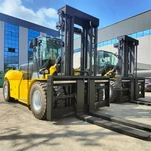
Front three-quarter view showing the wide mast, heavy carriage and large pneumatic tire stance.

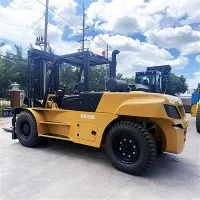
Side view showing the large wheelbase, cab, mast and rear counterweight.

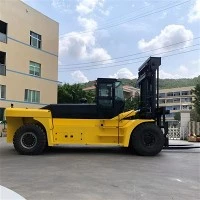
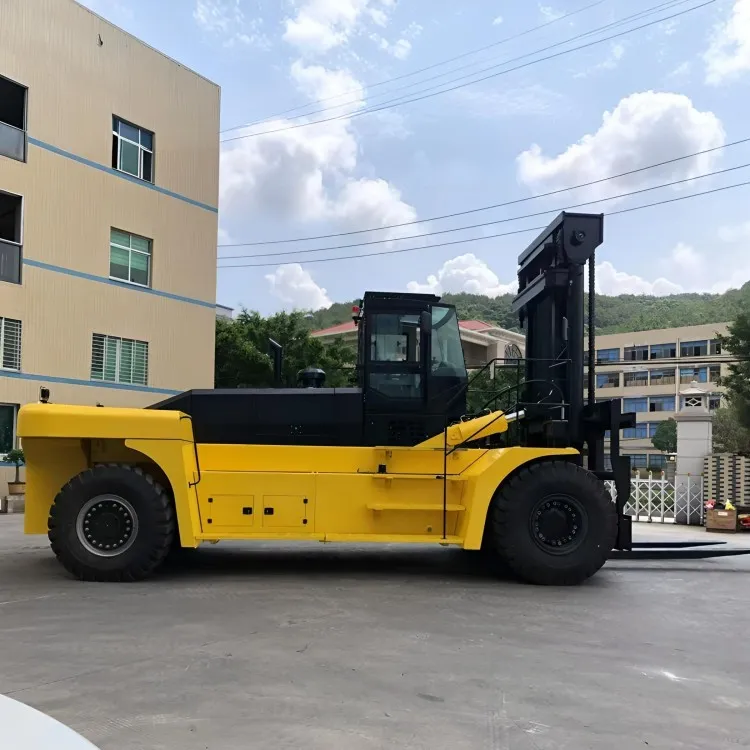
Full side profile for reviewing chassis, mast and counterweight proportions.
Published 40 Ton Forklift Specifications
| Area | Parameter | FD400 Published Data |
|---|---|---|
| Capacity | Rated Load | 40,000 kg |
| Capacity | Load Center | 1,250 mm |
| Weight | Service Weight | 51,000 kg |
| Chassis | Wheelbase | 5,500 mm |
| Chassis | Front / Rear Tread | 2,495 / 2,880 mm |
| Mast | Tilt Front / Rear | 6° / 12° |
| Mast | Lowered Mast Height | 5,040 mm |
| Mast | Lift Height | 4,000 mm |
| Mast | Maximum Height | 6,120 mm |
| Machine | Cab Height | 3,820 mm |
| Machine | Overall Length with Forks | 10,670 mm |
| Machine | Fork Face to Rear | 8,170 mm |
| Machine | Overall Width | 3,600 mm |
| Load Interface | Fork Dimensions | 2600 × 300 × 130 mm |
| Load Interface | Fork Spread, Min / Max | 910 / 2,830 mm |
| Load Interface | Fork Carriage Width | 3,300 mm |
| Clearance | Under Mast | 400 mm |
| Clearance | Wheelbase Center | 480 mm |
| Maneuvering | Minimum Turning Radius | 7,730 mm |
| Travel | Loaded / Unloaded Speed | 26 / 30 km/h |
| Hydraulics | Lifting Speed | 300 mm/s |
| Performance | Loaded Gradeability | 20% |
| Performance | Maximum Drawbar Pull | 240 kN |
| Tires | Front | 4 × 18.00-25-28PR |
| Tires | Rear | 2 × 16.00-25-28PR |
| Transmission | Forward / Reverse | 4 / 4 |
| Hydraulics | Operating Pressure | 21 MPa |
Match the 2.6 m Forks and 3.3 m Carriage to the Cargo
The published FD400 fork arrangement uses 2600 × 300 × 130 mm forks with an outside spread range of approximately 910–2,830 mm.
For machinery, coils, steel structures or fabricated cargo, verify whether the underside provides suitable fork-entry and support locations before approving the configuration.
- Maximum cargo weight
- Actual center of gravity
- Fork-entry direction
- Required insertion depth
- Support-point spacing
- Attachment mass and thickness
40 Tons Still Depends on Load Center
The detailed FD400 rating is tied to a 1,250 mm load center.
If the real center of gravity sits farther forward, submit a cargo drawing so usable capacity can be reviewed before production.
Detailed FD400 Configuration Uses Weichai WP12 and ZL80
The detailed FD400 specification identifies one complete powertrain combination. This is more useful for procurement than mixing engine and transmission brands from separate versions.
Plan around a 51 Ton Truck before Adding a 40 Ton Load
Actual route approval should also account for cargo projection, fork position, pavement bearing capacity, drainage transitions, slopes, gate openings, cross aisles and staging space.
36 Ton vs 40 Ton: This Is a Chassis-Step Decision
| Selection Item | FD360 Reference | FD400 Reference |
|---|---|---|
| Rated Capacity | 36,000 kg | 40,000 kg |
| Load Center | 1,250 mm | 1,250 mm |
| Operating / Service Weight | 42,200 kg | 51,000 kg |
| Wheelbase | 4,800 mm | 5,500 mm |
| Overall Width | 3,360 mm | 3,600 mm |
| Turning Radius | 6,900 mm | 7,730 mm |
| Fork Length | 2,400 mm | 2,600 mm |
| Fork Carriage | 3,000 mm | 3,300 mm |
| Main Buying Question | Can the smaller platform safely handle the real load? | Does the project justify the larger chassis and site footprint? |
36 Ton, 40 Ton or 45 Ton: Choose by Real Load Moment
Stay with the smaller platform when the real load and required margin fit its approved working condition.
Compare 36 Ton →Use FD400 when the project requires the 40,000 kg / 1,250 mm condition and the site can support its larger chassis.
Move higher when cargo weight or required capacity margin exceeds the approved FD400 condition.
Compare 45 Ton →Use FD400 for Fork-Supported Heavy Cargo, Not Every 40 Ton Task
Strong Fit
Heavy machinery, steel structures, large fabricated components and industrial cargo with defined fork support points.
Check Carefully
Coils, off-center machinery, limited fork pockets, custom clamps or cargo with a center of gravity beyond 1,250 mm.
Compare Another Machine
Dedicated ISO-container stacking, multi-row outreach or tasks that require a spreader instead of fork support.
See the Existing 40 Ton Heavy Forklift in Customer Yard Use
The current product page includes this customer-yard machine video. Use it as a visual reference for the heavy chassis and operating scale; the approved FD400 data sheet should control the final technical specification.
Typical FD400 Heavy-Load Tasks
Steel & Fabrication
Handle heavy fabricated structures, billets and large industrial loads after checking load center and fork support.
Machinery Manufacturing
Move large machine bases, presses and assemblies with known pickup points and center of gravity.
Heavy Yard Logistics
Transfer oversized cargo where pavement, access and turning zones support the 51-tonne truck platform.
Send the Cargo and Site Data before Confirming FD400
Cargo
Maximum recurring weight, dimensions and center of gravity.
Pickup
Fork entry, support points, spread and attachment.
Site
Pavement, gates, turning zones, slopes and operating route.
Build
Lift height, powertrain, emission requirement, quantity and destination.
Continue the Capacity and Equipment Selection
FD400 40 Ton Forklift Buying Questions
The detailed FD400 specification lists 40,000 kg rated capacity at a 1,250 mm load center. Use the actual cargo center of gravity when checking unusual loads.
The detailed FD400 data lists 2600 × 300 × 130 mm forks, a 3,300 mm carriage and a published fork spread of approximately 910–2,830 mm.
The published minimum turning radius is 7,730 mm. The actual operating envelope should also include fork projection, cargo length and working clearance.
The detailed FD400 specification lists a Weichai WP12G375E350 engine rated at 276 kW and a ZL80 transmission with four forward and four reverse gears. Confirm the exact ordered configuration before production.
Compare the 45 ton class when the real cargo weight, load moment or required operating margin exceeds the approved FD400 condition. Do not move up in tonnage without checking load center and site geometry.
Send maximum cargo weight and dimensions, center of gravity, fork-entry and support geometry, required lift height, attachment, pavement and route conditions, powertrain or emission requirement, quantity and destination.
Confirm the Cargo and Site before Moving to the FD400 Platform
Send the maximum recurring cargo weight, dimensions, center of gravity, fork-entry and support geometry, required lift height, attachment, yard dimensions, pavement and slope conditions, engine or emission requirement, quantity and destination. These inputs allow the 40,000 kg / 1,250 mm FD400 configuration to be checked against both the load and the larger 51-tonne truck footprint.
Hot Tags: 40 ton forklift, 40 ton diesel forklift, FD400 forklift, 40000kg forklift, 1250mm load center forklift, heavy duty forklift, heavy lift diesel forklift, FD50 forklift, 8t counterbalanced forklift, FD70 Forklift Truck, diesel 2 5 ton forklift, counterbalanced 4 ton forklift, FD35 3 5 ton diesel forklift