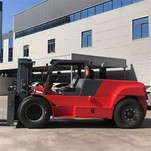
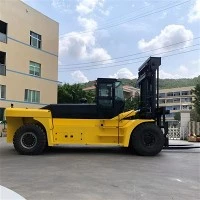
The Narrow Aisle Cushion Tire Forklift is a compact counterbalance truck engineered for high-density indoor facilities, including distribution centers, manufacturing plants, and commercial warehouses. By combining pressed-on cushion tires, a shortened chassis architecture, and tight steering geometry, this machine minimizes the turning envelope required on smooth, hard concrete surfaces.
Comparative Evaluation Matrix
|
Requirement |
Cushion Tire Forklift |
Pneumatic Tire Forklift |
Reach Truck |
VNA Articulated Forklift |
|
Smooth Indoor Floor |
High |
High |
High |
High |
|
Tight Turning Radius |
High |
Moderate |
High |
High |
|
Narrow Aisle Navigation |
High |
Low |
High |
High |
|
High-Rack Storage Access |
Moderate |
Low |
High |
High |
|
Outdoor / Rough Terrain |
Low |
High |
Low |
Low |
|
Counterbalance Operation |
High |
High |
Low |
High |
Typical Industrial Applications
Designed for versatility across diverse indoor industrial sectors, this forklift performs reliably in environments demanding high maneuverability and precise load placement:
Narrow warehouse aisles and high-density storage zones
Manufacturing and assembly line material supply
Distribution centers and cross-docking facilities
Block stacking and cold-storage staging areas
Indoor loading docks and paved transitional zones
Ideal Operating Environment
Smooth Indoor Floors
Designed for level, high-paved indoor finishes.
Space-Constrained Layouts
Reduces aisle clearance requirements compared to conventional pneumatic-tire equivalents.
Frequent Maneuvering
Optimized for tight turns around rack uprights, production lines, and staging zones.
Critical Selection Factors: Layout & Load Dynamics
Aisle performance is a system calculation. Selecting the correct model requires evaluating the interaction between the truck dimensions, rack configuration, and pallet geometry.
Technical Parameter Checklist
Aisle Width: Defines whether the chassis can enter, turn, and square up the load.
Load Center & Weight: Determines the center of gravity and residual capacity at elevated heights.
Mast Profile: Must match ceiling height, overhead obstructions, and the highest storage tier.
Fork Geometry: Length, thickness, and spread must secure the pallet without causing excessive front overhang.
Powertrain and Configuration Options
Electric Drive Systems
Zero local emissions for noise-sensitive, climate-controlled indoor spaces.
Suitable for facilities utilizing multi-shift battery management and fast-charging infrastructure.
LPG / Internal Combustion Configurations
Designed for operations requiring continuous multi-shift duty cycles with rapid fuel replenishment.
Requires appropriate indoor ventilation ratings and smooth, hard flooring.
Residual Capacity & High-Rack Limitations
Nominal capacity is only a baseline. For multi-tier warehouse configurations, operating safety depends heavily on residual load curves.
Elevation Derating: As the mast extends to higher storage levels, the physical center of gravity shifts forward, reducing the safe lifting capacity.
Attachment Impact: Integrating side-shifters, fork positioners, or custom clamps extends the load center and directly alters residual capacity limits.
Load Chart Verification: Procurement teams must evaluate model-specific load charts against maximum stacking heights rather than relying solely on nominal tonnage ratings.
Manufacturing & Quality Control Standards
Reliable fleet operation relies on strict production controls from initial component sourcing to final inspection.
Traceable Production Workflow
- Configuration Review
- Component Sourcing
- Chassis Assembly
- Powertrain Integration
- Hydraulic & Electrical Testing
- Final Quality Audit
Core Inspection Milestones
Structural Integrity: Rigorous checks of the chassis and mast assembly.
Hydraulic Performance: Verification of system pressure, lifting speed, and lowering control stability.
Operational Safety: Testing steering responsiveness, braking performance, and electronic safety interlocks.
Specification Compliance: Final verification of nameplate data, tire compound specifications, and optional attachments against approved technical drawings.
Global Compliance & Regional Certification Standards
Exporting material handling equipment to international markets requires strict adherence to destination-specific safety, electrical, and structural regulations.
Operator Protection: Overhead guards designed to meet recognized international impact and falling-object standards.
Electrical Safety: Wiring harnesses, connectors, and battery compartments insulated and secured for industrial operating conditions.
Emission Standards: Internal combustion power units configured to comply with local environmental and exhaust regulations for the destination market.
Documentation Support: Provision of compliance certificates, operator manuals, and maintenance guides tailored to regional import protocols.
FAQ
Q: What defines a narrow aisle cushion tire forklift?
A: It is a compact counterbalance truck engineered with solid cushion tires and a shortened chassis architecture, specifically designed to operate efficiently in space-constrained indoor facilities with smooth, hard floors.
Q: Can cushion tire forklifts operate outside on paved areas?
A: They can navigate smooth, well-paved indoor-outdoor transitional zones like loading docks. However, they are not built for unpaved terrain, gravel, or rough outdoor yards, where pneumatic tires are required.
Q: How do I calculate the correct aisle width requirement for my facility?
A: Aisle width is not a universal measurement. It depends on the truck's turning radius, load dimensions, pallet size, fork length, and clearance requirements at rack intersections. Providing your warehouse layout allows for an accurate calculation.
Q: Why does load capacity decrease at higher rack levels?
A: As the mast extends upward, the physical center of gravity shifts forward, reducing the residual lifting capacity. High-rack storage applications require verifying model-specific load charts rather than relying solely on nominal tonnage ratings.
Hot Tags: narrow aisle cushion tire forklift, China narrow aisle cushion tire forklift suppliers, factory, 7 ton diesel forklift With Full Free Triplex Mast, 8t counterbalanced forklift, diesel 10 tonforklift, diesel small 5 ton forklift, FD50, FD80 forklift truck