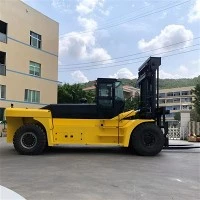
Four-wheel pneumatic tire forklifts are sit-down counterbalance industrial trucks engineered for palletized cargo and unit-load handling across manufacturing plants, distribution yards, loading docks, and building material facilities.
The pneumatic-tire configuration delivers superior ground compliance over minor surface irregularities compared to cushion tires, making it ideal for maintained outdoor asphalt, concrete yards, and transitional indoor-outdoor routes. Because industrial applications vary significantly, this equipment range can be tailored across lifting capacities, mast stages, power systems, fork dimensions, and specialized hydraulic attachments.
For professional buyers evaluating material handling suppliers, selecting the right machine requires looking beyond nominal tonnage. Operational safety and efficiency depend entirely on evaluating load weight, load center distance, lift height, operating surface conditions, duty cycles, aisle dimensions, and regional emission standards.
Key Specifications
|
Specification Parameter |
Standard Configuration Options |
|
Forklift Type |
4-wheel sit-down counterbalance industrial forklift |
|
Power Type |
Internal combustion engine (Diesel / LPG / Dual Fuel options) |
|
Tire Type |
Heavy-duty pneumatic tires (solid pneumatic options available) |
|
Rated Capacity Range |
Configurable across light, medium, and heavy industrial classes |
|
Load Center |
Specified per rated capacity and international standard metrics |
|
Mast Options |
2-stage standard view or 3-stage full free-lift configurations |
|
Lift Height |
Engineered according to facility clearance and stacking requirements |
|
Fork Dimensions |
Standard and application-specific custom lengths available |
|
Transmission |
High-efficiency automatic or power-shift configurations |
|
Steering System |
Responsive rear-wheel hydraulic power steering |
|
Braking System |
Hydraulic service brakes and reliable mechanical parking brakes |
|
Hydraulic Attachments |
Integrated side shifters, fork positioners, and clamp options |
|
Operator Environment |
Ergonomic sit-down cabin with open overhead guard or full enclosure |
Application Environments
Four-wheel pneumatic tire forklifts provide dependable service across demanding industrial sectors:
Manufacturing Plants: Transferring raw materials, heavy components, and finished goods between production lines, assembly bays, and shipping zones.
Distribution & Freight Yards: Staging and moving palletized cargo around busy loading docks and staging zones.
Building Material Facilities: Handling packaged timber, steel profiles, bricks, and heavy unit loads on maintained industrial yards.
Outdoor Storage Facilities: Managing continuous material transfer cycles moving between open yards and covered warehouses.
Loading & Unloading Operations: Providing stable counterbalance performance for rapid truck loading where adequate maneuvering space exists.
Mast and Lifting Configuration
Selecting the correct mast structure impacts vertical reach, facility clearance, and overall operational safety.
2-Stage Mast: Recommended for general material handling where lifting heights are moderate and overhead facility clearance is fully adequate. Offers excellent forward visibility through the mast channels.
3-Stage Mast: Essential when high-tier stacking is required while maintaining a low collapsed height to pass through standard factory doors, shipping containers, or low-ceiling bays.
Engineering Note: Always cross-reference required lifting height against available overhead clearance. Specifying lift height alone risks ordering a unit whose lowered mast cannot safely clear interior facility entryways.
Customization Options
Productivity can be significantly enhanced by integrating application-matched hydraulic attachments:
Side Shifter: Enables lateral movement of the forks for precise pallet alignment without maneuvering the entire truck.
Fork Positioner: Hydraulically adjusts fork spacing from the operator seat to handle varying pallet widths instantly.
Custom Fork Lengths: Tailored to match deep loads, non-standard pallets, and specialized center-of-gravity requirements.
Enclosed Cabin: Available with heating or climate control for protection against extreme weather, dust, or low-temperature environments.
Advanced Visibility Packages: LED work lights, strobe warning beacons, and panoramic rearview mirrors configured for safety compliance.
Manufacturing Quality & Technical Documentation
For global procurement projects, equipment compliance must be fully traceable from initial specification through manufacturing, export, and final commissioning.
Standard export documentation packages include:
Comprehensive machine specification datasheets
Detailed operation and maintenance manuals
Complete parts catalogs for future maintenance reference
Engine and powertrain compliance documentation
Electrical and hydraulic schematic diagrams
Factory quality inspection and testing records
Destination-market regulatory certificates and compliance declarations
FAQ
Q: What is a four wheel pneumatic tire forklift?
A: A four-wheel pneumatic tire forklift is a sit-down counterbalance industrial truck fitted with four pneumatic tires, designed for heavy-duty material handling across manufacturing plants, warehouses, and industrial yards.
Q: What is the difference between pneumatic and cushion tires?
A: Pneumatic tires feature deep treads and air-filled construction, offering excellent shock absorption over rough outdoor surfaces and paved yards. Cushion tires are smooth, solid rubber tires optimized strictly for smooth indoor concrete floors where tight turning radiuses are required.
Q: Is a pneumatic tire forklift suitable for rough terrain?
A: No. Standard pneumatic-tire forklifts are built for maintained industrial surfaces, asphalt, and concrete. Deep mud, unpaved gravel, and severe construction terrain require dedicated four-wheel-drive rough-terrain equipment.
Q: How do I determine the correct forklift capacity?
A: Start with your maximum load weight, then verify the load center distance, required lift height, and load dimensions. Capacities must always be evaluated under actual load geometry rather than nominal tonnage alone.
Q: Should I choose a 2-stage or 3-stage mast?
A: Choose based on your maximum lifting height and lowest overhead restriction. A 3-stage mast provides high vertical reach while maintaining a low collapsed height, making it ideal for facilities with height-restricted entryways.
Q: Can the forklift be equipped with a side shifter?
A: Yes. Integrated side shifters and hydraulic fork positioners can be added. Their weight and forward extension must be factored into final residual capacity calculations.
Q: Can engine configurations be adjusted for regional regulations?
A: Yes. Powertrains can be configured to meet destination-market emission standards and local fuel availability. Final engine specifications are locked in during the formal quotation stage.
Q: What information should I provide for an accurate quotation?
A: Provide your required rated capacity, maximum load dimensions, load center, lift height, operating surface conditions, daily working hours, preferred fuel type, destination country, and any required hydraulic attachments.
Hot Tags: four wheel pneumatic tire forklift, China four wheel pneumatic tire forklift suppliers, factory, 10t counterbalanced forklift, 2 5 Ton Diesel Forklift, 4 T Forklift, counterbalanced 2 ton forklift, CPCD80 FORKLIFT, Heavy Duty Fork Forklift 10 Ton