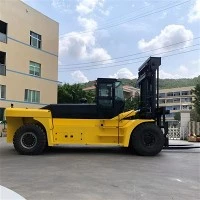
IC pneumatic tire counterbalance forklifts combine an internal-combustion powertrain, counterbalanced chassis and pneumatic tires for palletized and industrial load handling across factories, logistics yards, loading areas and maintained outdoor surfaces.
The range covers different capacity classes and configurations, allowing buyers to match the truck to actual load weight, load center, lifting height, working space and destination-market requirements.
For standard industrial applications, pneumatic tires provide more ground compliance than cushion tires while retaining the familiar counterbalance forklift layout. For heavily uneven terrain, deep mud, loose gravel or demanding off-road conditions, a dedicated four-wheel-drive rough-terrain forklift is a more appropriate choice.
Capacity Classes for Different Handling Requirements
|
Capacity Class |
Typical Procurement Requirement |
|
1.5–2.0 ton |
General pallet handling and lighter industrial loads |
|
2.5–3.0 ton |
General manufacturing and logistics applications |
|
3.5–5.0 ton |
Heavier pallets, machinery and industrial materials |
|
6–10 ton |
Heavy industrial loads and higher-capacity yard handling |
|
12 ton and above |
Heavy-duty industrial, port and specialized handling |
Where an IC Pneumatic Tire Forklift Fits
This forklift configuration is generally suited to operations that combine material handling with outdoor or semi-outdoor travel.
Manufacturing Plants: Move pallets, machinery, components, steel products and production materials between buildings, storage areas and loading zones.
Logistics & Freight Yards: Handle palletized cargo around loading docks, dispatch areas and freight transfer points where continuous travel is required.
Building Material Handling: Suitable for maintained yards handling packaged building materials, bricks, panels, pipes and other industrial products within the truck rated capacity.
Timber & Industrial Yards: Pneumatic tires provide additional compliance on maintained outdoor surfaces compared with cushion-tire configurations.
Loading & Unloading: The counterbalance layout allows the truck to approach pallets, trailers and loading areas without requiring front stabilizing outriggers.
Pneumatic Tires: What They Change
Pneumatic tires are particularly relevant when the forklift regularly travels between indoor and outdoor areas or operates on maintained industrial yards. Compared with cushion tires, pneumatic tires provide greater tire deformation over uneven surfaces and are commonly used where surface conditions are less controlled.
- Outdoor loading areas
- Concrete yards
- Asphalt
- Compacted industrial surfaces
- Freight yards
- Factory compounds
- Mixed indoor/outdoor routes
Tire size and ply rating should be confirmed against the truck capacity, operating surface and expected duty cycle. For instance, standard pneumatic configurations use specified tire sizes paired with a 600 mm load center and established outside turning radiuses.
Mast Selection: Lift Height Is Only One Part of the Decision
The required lift height should be considered together with the lowered mast height.
Required Lift Height: Specify the actual fork height needed at the highest placement position.
Lowered Mast Height: Check warehouse doors, loading bays, trailers, roof structures and other overhead restrictions before selecting a taller mast.
Free Lift: Free lift becomes important when loads need to be raised inside trailers, containers or low-clearance areas without excessive mast extension.
Mast Configuration: Depending on the model, different mast arrangements and lifting heights can be configured, including standard 3,000 mm configurations and higher mast options on selected models. Do not select the mast from maximum lifting height alone.
Load Center and Residual Capacity
Rated capacity is always associated with a specified load center. The load center is the horizontal distance from the fork face to the approximate center of gravity of the load. A longer crate, machine component or oversized pallet can move the load center forward even when the total load weight remains unchanged.
Before ordering, provide:
- Maximum load weight
- Load length
- Load width
- Load height
- Required fork length
- Required lift height
These values allow the final truck configuration and capacity requirements to be checked more accurately.
Engine and Emission Configuration
The engine should be selected according to both operating requirements and destination-market regulations. Available configurations can vary by capacity and destination, including established diesel power units with emission configurations available for regulated markets.
For export orders, confirm the following before production:
Engine manufacturer and model
Rated power and maximum torque
Emission standard compliance
Fuel system requirements
Destination-country regulatory mandates
Service and replacement-parts availability
Hydraulic and Transmission Configuration
The hydraulic system determines lifting response, attachment compatibility and control characteristics. The transmission affects acceleration, travel control and service requirements. Selected diesel models use hydraulic powershift transmissions and hydraulic gear-pump systems.
For orders with attachments, confirm:
- Auxiliary hydraulic circuit availability
- Hydraulic flow requirement and working pressure
- Hose connection layout
- Attachment weight and load center
- Required control functions
An attachment should not be added simply because its weight is below the nominal forklift capacity. Its load center and hydraulic requirements also affect the final configuration.
Fork and Attachment Configuration
Standard fork dimensions vary by capacity and model. Typical specifications utilize standard industrial forks, while longer or specialized forks can be configured when required by the load.
Common Configuration Options:
Standard forks
Side shifters
Fork positioners
Paper roll clamps
Bale clamps
Rotators
Specialized industrial attachments
The final attachment should be selected from the load geometry, weight, center of gravity and hydraulic requirements.
FAQ
Q: What is an IC pneumatic tire counterbalance forklift?
A: It is an internal-combustion forklift using a counterbalanced chassis and pneumatic tires. It is commonly used for industrial material handling across factories, loading areas and maintained outdoor yards.
Q: Is a pneumatic tire forklift suitable for outdoor use?
A: Yes. Pneumatic tires are commonly used for outdoor and mixed-surface industrial applications. However, a standard pneumatic counterbalance forklift should not automatically be treated as a rough-terrain machine.
Q: What is the difference between a diesel forklift and an IC forklift?
A: IC stands for internal combustion. Diesel is one type of IC powertrain. Gasoline and LPG forklifts are also internal-combustion forklifts.
Q: How do I choose the correct forklift capacity?
A: Start with the maximum load weight, load dimensions, load center and required lift height. Do not select the truck from load weight alone.
Q: Why is load center important?
A: The rated capacity is based on a specified load center. A longer load moves its center of gravity forward and can reduce the practical lifting capacity.
Q: What lift height should I specify?
A: Specify the actual fork height required at the highest storage or loading position, then check the lowered mast height against doorways and overhead restrictions.
Q: Are pneumatic tires suitable for rough terrain?
A: They can handle some uneven outdoor surfaces, but pneumatic tires alone do not make a forklift a rough-terrain machine. For deep mud, loose gravel, severe gradients or demanding off-road work, a four-wheel-drive rough-terrain forklift should be considered.
Q: Can the forklift use attachments?
A: Yes, depending on the truck configuration. Side shifters, fork positioners, clamps, rotators and other attachments can be specified, but attachment weight, load center and hydraulic requirements must be checked together.
Q: Can you supply different engines or emission configurations?
A: Engine and emission options vary by model and destination. The exact engine model, rated power and emission configuration should be confirmed before production.
Q: What information should I provide for a quotation?
A: Send the maximum load weight, load dimensions, load center if known, required lift height, fork length, attachment, operating surface, working hours, quantity and destination country.
Hot Tags: ic pneumatic tire counterbalance forklift, China ic pneumatic tire counterbalance forklift suppliers, factory, 4 T Diesel Forklift, 4 T Forklift, 7 Ton Diesel Forklift, 8t counterbalanced forklift, counterbalanced small 5 ton forklift, Hight quality 3 5 ton diesel forklift