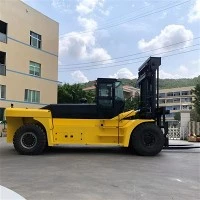
This compact counterbalance forklift is engineered for efficient pallet handling on smooth, hard surfaces where maximizing floor-space utilization and operational agility are essential.
Its low-profile cushion tire configuration reduces the overall chassis footprint, allowing for tight turning performance in dense warehouses, manufacturing plants, and paved distribution facilities. Built with a standard front counterbalance layout, it enables direct load handling without the need for outriggers or reach mechanisms.
Technical Specifications
|
Parameter |
Specification Profile |
|
Machine Type |
Cushion Tire Counterbalance Forklift |
|
Primary Operating Surface |
Smooth indoor concrete or paved hard surfaces |
|
Tire Configuration |
Solid cushion tires (low-profile, high stability) |
|
Mast Options |
Duplex and Triplex configurations (model dependent) |
|
Rated Capacity |
Application and load-center dependent |
|
Outside Turning Radius |
Optimized compact chassis geometry |
|
Available Attachments |
Side shifter, fork positioner, clamps (optional) |
|
Standard Export Compliance |
Factory testing, inspection reports, and operational documentation |
Core Engineering Features
Tight Turning Geometry
The short wheelbase and precision steering arrangement minimize the radius required for directional changes. This maximizes usable storage space in high-density rack environments, narrow production transfer aisles, and tight staging zones.
Specialized Cushion Tire Design
Cushion tires provide exceptional stability and a lower center of gravity compared to pneumatic tires. They are optimized for indoor facilities where ground clearance requirements are minimal, but floor traction, tire durability, and tight spatial navigation are critical.
Direct Counterbalance Handling
Without obstructing outrigger legs, operators can pick up, transport, and stack loads directly from the front. This streamlines routine workflows including trailer loading, cross-docking, and workstation material replenishment.
Customizable Mast & Attachment Compatibility
Lifting assemblies can be tailored to exact building dimensions, with options for standard, free-lift, and multi-stage masts.
Precision Selection Guide: 6 Steps to the Right Truck
Analyze Maximum Load Weight: Base the procurement decision on your heaviest and most frequent loads, including normal operating weight, dimensions, and center of gravity.
Calculate the Load Center: Recognize that longer or irregular loads increase the load moment, reducing available lifting capacity at elevated heights.
Verify Vertical Clearances: Measure exact rack storage heights, overhead door clearances, and collapsed mast dimensions to ensure proper overhead clearance.
Evaluate Aisle and Turning Space: Compare the truck's outside turning radius and right-angle stacking dimensions against your narrowest aisles and staging gates.
Match Floor Conditions: Confirm that operating areas are smooth, paved, and clean to get maximum performance out of cushion tires.
Integrate Attachments Early: Specify all clamp or shifting mechanisms prior to capacity finalization to ensure safe operational limits.
Quality Control & Factory Inspection Protocol
Every industrial truck undergoes rigorous quality verification before dispatch:
Incoming Material Checks: Raw structural components and sub-assemblies are verified against precise engineering blueprints.
Structural & Weld Integrity: Chassis alignment and frame welds are rigorously tested for load-bearing durability.
Hydraulic & Powertrain Testing: Complete pressure testing of hydraulic lines, cylinder movement, steering response, and braking systems.
Final Functional Trials: Dynamic testing covering driving, tilting, lifting speeds, instrumentation accuracy, and safety equipment validation.
Global Procurement & Export Support
For international fleet owners and equipment distributors, comprehensive logistical and technical documentation is prepared to match regional import regulations:
Commercial invoices, packing lists, and detailed technical data sheets.
Comprehensive operator manuals and spare parts catalogues.
Pre-shipment inspection records and certificates of conformity.
Tailored spare-parts packages (including high-wear items, filters, brake assemblies, and cushion wheels) available for multi-unit fleet orders.
Operator Ergonomics & Safety Systems
Cabin Design & Visibility
The operator compartment is engineered to reduce fatigue during high-frequency shifts. Key ergonomic features include:
Low-Step Entry: Wide, slip-resistant steps and accessible grab handles for safe mounting and dismounting.
Optimized Seat Positioning: Adjustable suspension seating with integrated operator restraint systems to absorb vibrations on hard indoor surfaces.
Clear-View Mast Design: Wide-spaced channels and hose routings that maximize forward visibility through the mast stages during high-tier stacking.
Active & Passive Safety Equipment
Operator Presence Sensing System (OPS): Automatically disengages travel and hydraulic functions if the operator leaves the seat.
Overhead Guard: Heavy-duty structural canopy designed to protect the driver from falling objects, built in compliance with international stability standards.
Lighting & Warning Packages: Includes LED working headlights, rear combination lights, backup alarms, and amber strobe lights for high-traffic warehouse safety.
FAQ
Q: What makes a cushion tire forklift better for indoor use than a pneumatic model?
A: Cushion tires provide a smaller overall machine footprint and a tighter turning radius, making them highly efficient in confined indoor spaces. Their solid rubber construction also offers exceptional stability on smooth concrete floors where puncture resistance and low rolling resistance are beneficial.
Q: Can the turning radius be reduced further by changing the fork length?
A: While changing fork lengths alters the overall load center and combined turning geometry, standardizing forks to match your specific pallet dimensions is the safest way to optimize right-angle stacking aisles without compromising stability.
Q: How do incline and ramp conditions affect cushion tire truck performance?
A: Cushion tires are designed primarily for flat, level indoor floors. While they can handle slight, paved transitions or loading docks, steep ramps, wet surfaces, or unpaved inclines significantly reduce traction and braking efficiency, making them unsuitable for severe slope operations.
Q: What maintenance is required for solid cushion tires?
A: Unlike pneumatic tires that require regular air pressure checks and carry puncture risks, solid cushion tires are maintenance-free regarding inflation. However, they should be inspected periodically for wear, chunking, or separation from the steel band, and replaced when they reach the manufacturer's safety wear line.
Hot Tags: tight turning radius cushion tire forklift, China tight turning radius cushion tire forklift suppliers, factory, 3 Ton Diesel Forklift, 7t Handler Diesel Forklift Truck, counterbalanced small 5 ton forklift, FD35, Heavy Duty Fork Forklift 10 Ton, how much of 10 ton diesel forklift