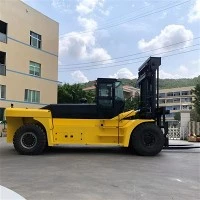
Selecting the correct industrial forklift for heavy building materials requires evaluating more than nominal tonnage. True operational efficiency depends on analyzing actual load geometry, center of gravity shift, lift heights, ground gradient conditions, and duty cycles.
A mismatch between equipment specifications and job-site realities leads to premature component wear, reduced residual capacity, and safety hazards. This guide outlines the engineering parameters required to match the right heavy-lift machine to your operating environment.
Typical Technical Specification Reference
|
Parameter |
Standard Diesel Counterbalance |
Heavy-Duty Industrial Model |
Rough Terrain Forklift |
|
Rated Capacity |
1.5 to 10 Tons |
16 to 52 Tons |
3 to 5 Tons |
|
Load Center |
500 mm / 600 mm |
600 mm to 1200 mm |
500 mm / 600 mm |
|
Lift Height |
3,000 to 6,000 mm |
3,000 to 5,500 mm |
3,500 to 6,000 mm |
|
Drive System |
2WD |
Heavy-Duty 2WD |
4WD |
|
Tire Type |
Pneumatic or Solid |
Heavy Industrial Pneumatic |
Rough Terrain Deep-Tread |
|
Engine |
High-Torque Diesel |
Heavy-Industrial Diesel |
Off-Highway Diesel |
Core Engineering Features & Advantages
Reinforced Structural Integrity: Engineered with high-strength steel masts and a heavy-duty chassis to prevent structural deflection under maximum capacity, ensuring long-term durability in harsh construction environments.
Advanced Load-Sensing Hydraulics: Intelligent hydraulic systems deliver power precisely when needed. This optimizes lifting and tilting speeds while significantly reducing fuel consumption and preventing system overheating.
Rugged Drivetrain Performance: Equipped with high-torque transmissions and reinforced drive axles to ensure smooth acceleration, superior gradeability on steep slopes, and reliable power transfer across uneven terrain.
Optimized Operator Ergonomics: Full-floating cab designs featuring premium suspension seats and advanced vibration isolation reduce operator fatigue during extended shifts, directly improving daily productivity.
Enhanced Visibility & Safety: Wide-view mast designs and optimized hydraulic hose routing provide operators with an unobstructed line of sight to the load and fork tips, maximizing operational safety in busy material yards.
Matching Equipment to Operating Conditions
Selecting machinery based purely on advertised capacity often results in operational bottlenecks. Performance must be evaluated against the physical environment and load profile.
Paved Storage Yards & Logistics Hubs: Standard industrial diesel counterbalance models provide high maneuverability and efficient stacking cycles on asphalt or concrete.
Unpaved Construction & Project Sites: Four-wheel drive rough-terrain configurations with specialized traction tires, higher ground clearance, and robust oscillating axles manage gravel, mud, and uneven slopes.
Heavy Industrial & Precast Yards: High-capacity heavy-duty models handle concentrated loads, oversized steel components, and massive stone blocks safely.
Extended Reach Applications: Telehandlers provide forward outreach and high-reach capabilities, essential for multi-level construction and placing materials across obstacles.
Mixed Material Facilities: Integrating quick-detach hydraulic mechanisms allows rapid switching between standard forks, booms, and material clamps.
Specialized Material Handling Profiles
Different building materials impose distinct mechanical stresses on material handling equipment:
Bricks, Blocks, and Palletized Goods: Standard pallet configurations require accurate fork spacing and secure carriage alignment to prevent load shifting during high-tier stacking.
Structural Steel & Profiles: Long steel beams and pipes extend beyond standard pallet footprints, necessitating extended fork dimensions, wide load stabilizers, or specialized jib attachments.
Precast Concrete & Stone Blocks: High-density materials create intense point loads. Machines require reinforced carriage structures, heavy-duty steer axles, and high-capacity hydraulic tilt cylinders.
Lumber and Timber Products: Outdoor timber yards demand pneumatic or solid-cushion tires with deep tread patterns to maintain traction across wet, debris-strewn surfaces.
Maintenance, Safety, and Total Cost of Ownership
Preventative Maintenance: Dusty construction environments accelerate filter wear and hydraulic cylinder stress. Regular pre-operation checks and fluid analyses prevent pump failures and extend drivetrain life.
Operator Safety: Modern heavy-lift units feature stability management, automatic tilt leveling, and seat-interlocked hydraulic lockouts to minimize tip-over risks on uneven ground.
Total Cost Control: Factoring in fuel efficiency, tire lifespan, and routine service downtime prevents premature mechanical wear and optimizes long-term fleet budgeting.
Global Compliance and Certification Standards
Design & Stability Codes
Ensure equipment adheres to recognized international manufacturing and stability standards (such as ISO criteria).
Cab Safety Ratings
Verify that protective overhead structures meet mandatory Roll-Over Protective Structures (ROPS) and Falling-Object Protective Structures (FOPS) safety certifications.
Documentation Package
Procure complete parts catalogs, multilingual operator manuals, service records, and certificates of conformity to streamline customs clearance and safety audits.
FAQ
Q: How does load center distance affect lifting capacity?
A: Rated capacity is calculated using a standard load center (typically 500 mm or 600 mm). If building materials are wider or off-center, the center of gravity shifts outward, reducing residual lifting capacity and stability. Always consult the specific load chart for non-standard loads.
Q: Pneumatic vs. solid tires: which should I choose?
A: Pneumatic tires are air-filled, offering shock absorption and traction on unpaved gravel or rough yards. Solid tires are puncture-proof, making them ideal for paved, debris-heavy industrial surfaces where sharp objects cause flats.
Q: When should I choose a telehandler over a counterbalance forklift?
A: Choose a telehandler when your project requires both vertical lift height and horizontal forward reach. While conventional forklifts move only vertically, a boom allows operators to place loads across obstacles, scaffolding, and transport trucks.
Hot Tags: building material handling forklift, China building material handling forklift suppliers, factory, 3 5 Ton Diesel Forklift, 7 ton diesel forklift With Full Free Triplex Mast, diesel 12 ton forklift, FD25 2 5 ton diesel forklift, Hight quality 3 5 ton diesel forklift, Small 5 Ton Diesel Forklift Work In Container