Select a reach truck around the operator's work cycle
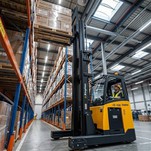
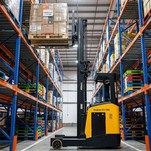
A stand-on electric reach truck with proportional valve control is intended for indoor rack handling where the operator needs controlled hydraulic response and a compact working position. Its value depends on how well the truck matches the pallet route, rack height, aisle geometry and battery routine-not on a single headline specification.
Available selection ranges include 1,500–2,000 kg capacity options, mast configurations up to 12.5 m, an AC drive and a side-extraction lead-acid battery arrangement. These are range-level selection points. The ordered truck should be defined by an approved specification and residual-capacity chart.
1
Start with the route
Map travel, rack approach, turning space, pedestrian crossings and the points where the operator enters or leaves the truck.
2
Define the top load
State pallet weight, load center and highest fork position so the correct mast and residual capacity can be checked.
3
Plan the energy routine
Match battery arrangement and charger to shift length, charging windows and the site's battery-handling procedure.
When a stand-on layout suits the operation
The operator-position choice should follow the work pattern. A stand-on layout can suit warehouse routes that combine rack handling with repeated short travel cycles and regular interaction with nearby staging or picking areas. The platform, controls, entry opening and protection structure must still be reviewed on the actual configuration.
A truck that spends most of its shift travelling longer distances may call for a different operator arrangement. Likewise, an extremely narrow aisle or floor-to-floor route may require a different truck category. Compare the working cycle instead of assuming that every indoor rack application needs the same reach truck.
Useful site inputs
- Travel distance per handling cycle
- Mount-and-dismount frequency
- Average and peak pallet moves per hour
- Clear aisle and turning dimensions
- Pedestrian and doorway interfaces
- Floor joints, ramps and transitions
- Shift length and planned breaks
What proportional valve control changes
Proportional hydraulic control is designed to vary hydraulic response according to the operator's input rather than relying only on a simple on/off command. For rack work, the practical aim is to give the operator better control during approach, fork positioning and withdrawal. Actual function mapping and response settings depend on the truck configuration.
Lift and lowerCheck how speed changes with control input and whether the response remains predictable with and without a load.
Reach movementReview extension and retraction response at the rack face under the intended pallet and height conditions.
Tilt controlConfirm the available tilt range and how the function is controlled on the proposed carriage and mast.
Function priorityAsk which combined hydraulic movements are permitted and how the controller manages simultaneous commands.
Configuration points for the technical proposal
The following range information helps establish the inquiry, while the right-hand column identifies the data that should appear on the final proposal.
| Selection area | Series information | Required confirmation |
|---|---|---|
| Operator position | Stand-on product positioning | Platform layout, entry direction, controls, guard and operator-clearance dimensions |
| Rated capacity | 1,500–2,000 kg selection range | Selected rating, stated load center and residual capacity at each required lift height |
| Mast range | Triplex configurations up to 12.5 m | Fork height, free lift, closed mast height, extended height and building clearance |
| Hydraulic control | Proportional valve control | Controlled functions, joystick layout, response settings and acceptance-test method |
| Traction system | AC drive is listed for the series | Travel speed settings, braking behaviour, gradient limits and site commissioning |
| Battery handling | Side-extraction lead-acid arrangement is presented | Battery voltage/capacity, tray dimensions, connector, extraction equipment and charger |
| Visibility assistance | Camera/display availability is configuration-dependent | Confirm whether supplied, its mounting position, viewing coverage and status as standard or optional |
Send your route and rack data
Provide the pallet weight and size, top fork height, clear aisle, travel route and shift pattern. These inputs allow the truck layout, mast, battery and residual-capacity requirement to be reviewed together.
Review the operator interface as a complete system
Entry and standing position
Check entry width, step height, standing area, back or side support and the operator's ability to keep within the protected envelope. The evaluation should include the clothing and safety footwear used on site.
Control reach and handover
Confirm that travel and hydraulic controls can be reached from the intended posture. The emergency-stop location, direction selector and horn should be included in operator familiarisation.
Visibility at rack level
Review mast-channel visibility, fork-tip reference, load obstruction and the top beam. A camera or display can assist only when the actual mounting and field of view suit the application.
Floor feedback
Joints, damaged areas and transitions affect vibration and load behaviour. Record problem locations during the site survey and include them in the trial route and maintenance plan.
Make battery changing a controlled warehouse process
A side-extraction battery arrangement can support multi-shift planning when the site has the correct change equipment, clear space and trained personnel. Battery mass should not be treated as a casual handling task. The battery, tray, restraint, connector and extraction method must be compatible.
Define the duty
Document shifts, operating hours, peak periods and available charging or change windows.
Match the system
Approve the traction battery, charger, connector and electrical supply as one package.
Prepare the area
Plan a level change location, access control, ventilation and the approved extraction device.
Control the exchange
Use the supplied procedure for isolation, restraint release, connection and post-change inspection.
Compare the truck type before fixing the specification
| Truck format | Use it as the first comparison when | Check carefully |
|---|---|---|
| Stand-on reach truck | The route includes compact indoor rack work, short travel cycles and a stand-on operating pattern | Operator-space design, aisle fit, residual capacity and battery-change workflow |
| Sit-down reach truck | Longer travel cycles or the selected operator environment make a seated arrangement worth comparing | Overall dimensions, turning behaviour, seat/controls and equivalent rack performance |
| VNA articulated forklift | Aisle width is a dominant constraint or the route combines narrow aisles with other warehouse areas | Guidance concept, transfer route, floor tolerance and operator training |
| Electric pallet stacker | The required lift, throughput and travel distance may be handled by a simpler warehouse truck | Capacity at height, travel frequency, operator arrangement and expected duty |
For a deeper layout comparison, read the VNA articulated forklift versus reach truck guide.
Prepare the approval pack before production
Truck and warehouse data
- Model and operator-position drawing
- Overall and turning dimensions
- Working-aisle calculation with the stated pallet
- Mast closed, free-lift and extended dimensions
- Load chart for the selected mast and load center
- Fork, carriage and attachment details
Power and delivery data
- Battery, charger and connector specifications
- Battery extraction and restraint procedure
- Control-function and option schedule
- Inspection or acceptance records agreed in the order
- Packing and transport dimensions
- Operating and maintenance documents
The acceptance plan can identify the representative pallet, target lift height, travel route, hydraulic-control checks and battery-change demonstration. Commercial terms such as delivery time, warranty scope, commissioning and spare parts should be stated in the quotation or contract for the specific order.
Related warehouse equipment
Electric Reach Truck RangeCompare operator formats, capacity classes and high-rack configurations. 1.5 t High-Lift Reach TruckReview a dedicated 1.5 t option for lighter pallet-handling requirements. 48V Lithium-Ion Reach TruckCompare a lithium-powered high-rack approach with the battery-change workflow on this page. 12.5 m Heavy-Duty Reach TruckEvaluate the high-lift series when top-level residual capacity drives the project.
Stand-on reach truck questions
What is the main benefit of proportional valve control?
It is designed to vary hydraulic response with the operator's control input, supporting more controlled lift, lower, reach or tilt movements when those functions are included. The exact function map and settings should be confirmed on the proposed truck.
Is a stand-on reach truck always better for narrow aisles?
No. Aisle suitability depends on the complete truck dimensions, pallet, rack and manoeuvre. Compare the calculated working aisle with sit-down reach trucks, VNA equipment or stackers where the route or duty suggests another format.
Can the truck carry 2,000 kg at 12.5 m?
They are separate range limits and should not be combined into one performance claim. Capacity at height depends on the selected mast, load center, carriage, forks and attachment. Use the approved residual-capacity chart.
What is needed for a side-extraction battery change?
The site needs a compatible battery and tray, approved extraction equipment, a level controlled area, suitable clearance and a written change procedure. Connector and restraint compatibility must be checked before operation.
Is a mast camera included as standard?
Do not assume inclusion from a general product description. Confirm the option schedule, mounting details, viewing coverage and the exact components supplied with the ordered truck.
What should be supplied before order approval?
Request the approved specification, dimensions, working-aisle data, load chart, mast information, battery and charger data, option list, agreed inspection scope, packing information and operating documents.
Request specifications and a quotation
Send the maximum pallet weight, load center, highest fork position, clear aisle, shift schedule and battery preference for a stand-on electric reach truck with proportional valve control proposal.
Hot Tags: stand-on electric reach truck with proportional valve control, China stand-on electric reach truck with proportional valve control suppliers, factory