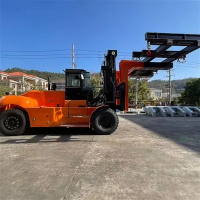
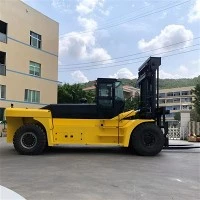
The 4 wheel sit down electric forklift is a counterbalanced industrial truck engineered for pallet handling, container loading, production logistics, and general material movement. Its four-wheel chassis delivers a stable platform for applications where load capacity, directional stability, and controlled maneuvering take priority over an ultra-tight turning radius.
Configurations cover compact 1.5–3.5 ton classes alongside heavier 4–7 ton electric heavy-duty models. Mast heights, battery systems, fork dimensions, and hydraulic attachments are matched directly to operational cycles and load profiles.
Technical Specifications
|
Specification |
Standard Selection / Available Configuration |
|
Machine Type |
4-Wheel Sit-Down Electric Counterbalance Forklift |
|
Rated Capacity |
1,500 kg – 7,000 kg (Model Dependent) |
|
Standard Load Center |
500 mm (Compact Models) |
|
Drive System |
AC Electric Drive |
|
Energy Storage |
Lead-Acid or Lithium-Ion (LiFePO4) |
|
Operating Voltage |
48 V / 80 V configurations |
|
Standard Lift Height |
3,000 mm (Base configuration) |
|
Maximum Lift Height |
Mast and model dependent |
|
Mast Options |
Duplex / Triplex (Full Free Lift available) |
|
Steering System |
Hydraulic rear-wheel steering |
Application Guide
Warehouses & Distribution Centers: Optimized for high-throughput pallet handling, receiving, and staging. Requires careful matching of aisle width and rack heights.
Manufacturing Plants: Transports raw materials, heavy tooling, and finished goods between production lines and storage bays.
Logistics & 3PL Facilities: Requires flexible fork and attachment options to handle diverse customer pallet dimensions.
Loading Docks & Paved Yards: Designed for trailers and paved outdoor staging areas. Ground conditions must remain firm and even.
Key Product Configuration
Four-Wheel Counterbalance Chassis: The counterbalanced frame enables the truck to carry loads in front of the drive axle without outriggers, ensuring a predictable footprint for stacking, loading, and transport.
Sit-Down Operator Position: Designed for repetitive tasks where operators spend extended hours traveling, lifting, and reversing, offering a familiar operating layout for industrial facilities.
Electric Drive System: AC traction motors and electric hydraulic pumps eliminate combustion emissions at the point of operation. Available with high-capacity lead-acid or lithium-ion energy storage systems.
Hydraulic Mast System: Configured using duplex or triplex arrangements to balance stacking height requirements against doorway clearance and low-overhead constraints.
Battery Selection & Charging Infrastructure
Battery capacity cannot be selected through amp-hours alone. Correct sizing requires analysis of operating hours, shift frequency, ramp gradients, and facility power supply.
Lead-Acid Systems: Suitable when initial capital expenditure is a priority. Requires structured charging intervals and dedicated, ventilated battery-changing space for single- or predictable double-shift operations.
Lithium-Ion Systems: Ideal for multi-shift operations. Supports opportunity charging during breaks without damaging cell lifespan, eliminating daily watering and maintenance.
Charging Infrastructure Match: Facilities must evaluate incoming voltage (e.g., single-phase vs. three-phase industrial power) and charger output amperage to ensure fast, safe replenishment within designated shift windows.
Operator Safety & Ergonomics
For compliance and operator protection in industrial environments, standard features include:
Operator Presence Sensing (OPS): Automatically cuts hydraulic lifting and travel functions when the operator leaves the seat.
Cabin Layout: Adjustable suspension seating, low-effort steering column, and clear mast-channel visibility to minimize operator fatigue during prolonged shifts.
Lighting & Warning Systems: Full LED working lights, amber strobe beacons, and reverse travel buzzers.
Configuration & Customization Options
Energy Storage
Lead-acid or lithium-ion chemistry, tailored charger outputs, and customized battery compartment dimensions.
Mast Assemblies
Two-stage duplex, three-stage triplex, and specialized low-clearance container masts.
Fork Specifications
Extended lengths, specialized widths, and non-standard cross-sections for heavy bulk materials.
Attachments
Integrated side shifters, fork positioners, paper roll clamps, and bale clamps (subject to hydraulic capacity checks).
FAQ
Q: What is a 4-wheel sit-down electric forklift?
A: It is a counterbalanced industrial lift truck powered by an electric drive system with a seated operator station, built for stable pallet transport and stacking.
Q: How does it differ from a 3-wheel electric forklift?
A: A 3-wheel model is optimized for tight turning radiuses in confined spaces, whereas a 4-wheel model provides a wider wheelbase footprint for enhanced stability during general-purpose material handling.
Q: Does a 2.5-ton forklift lift 2,500 kg at any height?
A: No. Rated capacity decreases as lift height increases or if the load center extends beyond the standard 500 mm threshold.
Q: Should I choose lead-acid or lithium-ion power?
A: Choose lead-acid for predictable, single-shift operations with dedicated charging infrastructure. Choose lithium-ion for multi-shift schedules requiring fast opportunity charging during breaks.
Q: Can this forklift operate outdoors?
A: Yes, on level, paved concrete or asphalt surfaces. Rough, unpaved terrain or gravel yards require dedicated rough-terrain equipment.
Hot Tags: 4 wheel sit down electric forklift, China 4 wheel sit down electric forklift suppliers, factory, 3 5t electric counterbalanced forklift truck, 3 ton forklift truck, 7 ton lead acid electric forklift, electric forklift 5 ton, FB35 electric forklift, forklift truck 5 ton