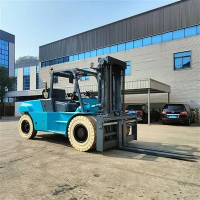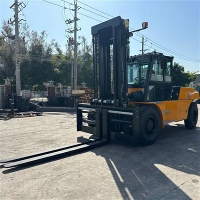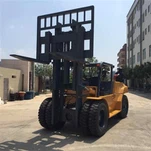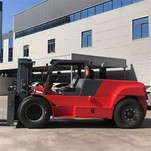


16-ton diesel yard forklift
Fork-based handling for empty-container workflows
The empty container forklift combines a 16,000 kg rated capacity at a 600 mm load center with 1,800 mm forks and a 3,000 mm standard lift. It is intended for port, depot and heavy-logistics teams that move compatible empty containers or other long loads at ground and loading-height positions.
Unlike a purpose-built empty-container handler with a top-lift spreader, this machine engages the load with forks. That makes fork-pocket geometry, container condition, load center and the approved load chart central to model selection.
Get Expert AdviceBest fit
Sites seeking a conventional heavy-duty forklift layout for compatible empty-container transfer, trailer interface and short-distance yard movement.
Choose another machine whenYour operation requires multi-high empty-container stacking, top-lift engagement, loaded-container handling or reach over another row.
Core data for an initial fit check
16,000 kgRated capacity at the stated 600 mm load center
3,000 mmStandard lifting height
4,880 mmMinimum turning radius
18,000 kgListed service weight
92 / 97 kWRated power by listed engine selection
1,800 mmFork length; section 180 × 90 mm
Capacity is geometry-dependent. The 16,000 kg rating is stated at a 600 mm load center. A long container produces a very different load geometry, so the project-specific residual capacity, fork-pocket position and approved handling method must be confirmed before purchase or operation.
What the machine configuration shows
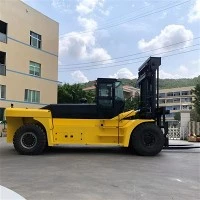
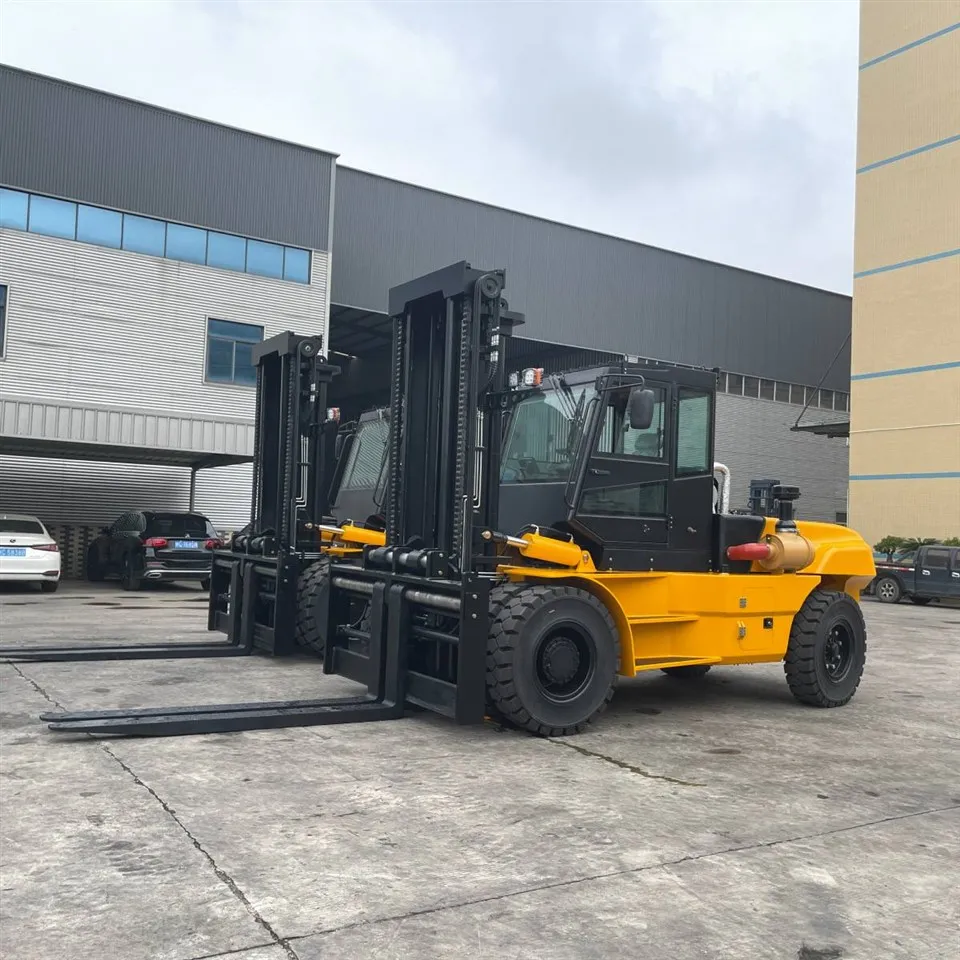
The product images show a diesel counterbalance chassis, enclosed cab, upright mast and long forks. This layout keeps the operating logic familiar to trained heavy-forklift drivers while providing the mass, tyre package and fork section listed for the model.
The 3,000 mm standard lift and 4,440 mm maximum working height position the machine around low-level transfer rather than the tall stacking patterns associated with dedicated empty-container handlers. The listed 22 km/h loaded and 28 km/h unloaded travel speeds should be evaluated against site speed limits, surface quality and traffic separation rules.
- Direct fork engagement for loads with verified pockets or approved lifting points
- Counterbalance layout for ground-level pickup and placement
- Enclosed operator compartment for outdoor yard duty
- Pneumatic tyre sizes listed as 12.00-20 front and 11.00-20 rear

Side profile showing the counterbalance chassis, mast, long fork arms and tyre layout.
Technical specification
| Rated load capacity | 16,000 kg |
|---|---|
| Rated load center | 600 mm |
| Service weight | 18,000 kg |
| Standard lifting height | 3,000 mm |
| Maximum working height | 4,440 mm |
| Minimum turning radius | 4,880 mm |
| Gradeability, loaded | 20% |
| Standard engine | Yuchai YC6B125-T21 |
|---|---|
| Optional engine | Dongfeng Cummins 6BT5.9-C130-II |
| Rated power | 92 / 97 kW |
| Travel speed, loaded / unloaded | 22 / 28 km/h |
| Fork dimensions | 1,800 × 180 × 90 mm |
| Front / rear tyres | 12.00-20 / 11.00-20 |
| Listed application | ISO 20 ft / 40 ft container handling |
Final configuration and performance data should be confirmed on the signed technical agreement and model-specific load chart.
Verify the load interface before comparing quotations
01 · Container
Identify the exact unit
Record container length, tare mass, condition and whether compliant forklift pockets are present. "20 ft" or "40 ft" alone is not enough to approve a lift.
02 · Geometry
Map forks to pockets
Confirm pocket opening, spacing, insertion depth, ground clearance and the resulting center of gravity. Check that the fork section and length suit the actual interface.
03 · Capacity
Approve the real load case
Use the manufacturer's load chart for the selected mast and attachment. Include any offset, uneven mass distribution and residual capacity requirement.

Rear view showing the wide counterweight, enclosed cabs and rear tyre stance.
Site conditions that affect the selection
A paper specification cannot determine whether the truck can work productively in a specific yard. A layout check should cover the full travel path, not only the pickup point.
- Aisle and turn space: compare the 4,880 mm turning radius with container corners, trailers, fences and pedestrian zones.
- Surface: confirm pavement strength, drainage, gradients, joints and pothole control for an 18,000 kg machine plus load.
- Overhead clearance: measure doorways, canopies, cables and other obstructions against the mast and maximum working envelope.
- Traffic plan: define one-way routes, speed limits, exclusion zones and reversing controls.
- Duty cycle: provide moves per hour, travel distance, shift duration and idle pattern when selecting engine and cooling configuration.
Forklift or purpose-built handler?
This fork-based model may fit when
- The empty container has verified, compatible fork pockets
- Work is mainly pickup, trailer transfer and short yard repositioning
- The required lift height stays within the approved low-level envelope
- The site prefers a familiar heavy counterbalance forklift format
Compare an empty-container handler when
- Containers must be engaged from the top with a spreader
- Multi-high stacking is a daily operating requirement
- Side shift, pile alignment and container-specific visibility are priorities
- Yard throughput depends on repeated container stacking cycles
For tall stacking, review the empty container handler range. For other fork-based capacities, compare the container forklift range.
Information to include with your enquiry
A complete application brief allows the engineering team to confirm the handling interface and avoid an unsuitable quotation. Please provide:
Load details
Container standard, length, tare mass, fork-pocket drawing and photos of the intended lifting points.
Operating pattern
Pickup and placement heights, moves per hour, one-way travel distance, gradients and shift length.
Site constraints
Minimum aisle width, doorway height, pavement condition, climate, local fuel and emission requirements.
Questions buyers often ask
Can this empty container forklift lift any 20 ft or 40 ft container?
No blanket approval should be assumed. The container must have compatible, serviceable forklift pockets, and the actual mass, center of gravity, fork insertion and model load chart must all be checked for the proposed lift.
Does the 16,000 kg rating mean it can handle a 16-ton container?
The stated rating applies at a 600 mm load center. Container geometry creates a different load center, so only the approved residual-capacity calculation and load chart can determine the permissible load.
Is this model intended for loaded containers?
This page positions the model for empty-container work. Loaded-container handling should not be inferred from the nominal capacity; request a separate engineering review and consider equipment designed for that application.
How high can this forklift lift?
The listed standard lifting height is 3,000 mm and the listed maximum working height is 4,440 mm. Confirm how each dimension is defined and request the selected mast drawing before planning clearances or placement heights.
Which engine is supplied?
The listed standard engine is the Yuchai YC6B125-T21. A Dongfeng Cummins 6BT5.9-C130-II is listed as an option. Availability and emissions suitability should be confirmed for the destination market.
What should be submitted for a technical recommendation?
Send the container specification and fork-pocket drawing, actual tare mass, pickup and placement heights, yard layout, surface and gradient information, duty cycle, climate, destination country and required documentation.
Explore related equipment
Confirm the load case before choosing the truck
Share the container drawing, fork-pocket dimensions, placement height and yard layout for a configuration review.
Request a Technical ReviewHot Tags: empty container forklift, China empty container forklift suppliers, factory, Heavy duty reach stacker, reach stacker, Container heavy duty forklift, 45 ton container stacker forklift, 45 ton reach stacker with axletech axle, 45 ton electric reach stacker