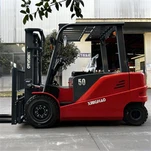
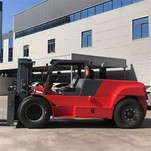
The working principle of telescopic forklift mainly includes its structural design, operation process and control system.
Structural design
Telescopic forklifts are usually composed of the following main parts:
Upper fork arm (front fork arm): responsible for the operation at the front end, usually in direct contact with the goods.
Middle fork arm: connects the upper fork arm and the lower fork arm, and plays the role of transmitting force and movement.
Lower fork arm (fixed fork arm): installed on the cargo platform, plays the role of support and fixation.
Guide roller, gear rack, sprocket chain, guide slider, limit switch (travel switch), middle switch (proximity switch), torque limiter, encoder, driver, motor, reducer, coupling and other components together constitute a complete telescopic mechanism to ensure the stable operation and precise control of the forklift.
Operation process
The working process of the telescopic forklift can be divided into the following steps:
Starting: Start the forklift engine to ensure that all systems are working properly.
Positioning: Determine the position of the goods through the control system and adjust the forklift to the appropriate working position.
Telescopic operation: Use the motor to drive the gear rack or sprocket chain to make the upper fork arm continue to extend outward from the midpoint of the middle fork arm to complete the cargo pick-up and placement operation. If it is a double-extension structure, a section or section of the fork body will be added to accommodate a longer operating distance.
Positioning and limit: Ensure that the forklift stops at the correct position through limit switches and proximity switches to avoid overload or damage.
Safety protection: Components such as torque limiters and encoders ensure safety during operation and prevent overload and misoperation.
Control system
The control system of a telescopic forklift usually includes the following parts:
Motor: Provides power to drive the gear rack or sprocket chain.
Reducer: Reduces the speed, increases the torque, and ensures stable operation.
Coupling: Connects the motor and reducer to transmit torque.
Encoder: Records the movement state of the forklift and provides accurate position feedback.
Driver: Controls the start and stop of the motor to achieve precise control.