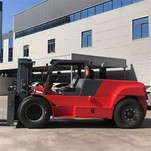
The main functions of container forklifts include stacking empty containers, loading and unloading containers, and short-distance transportation. They are particularly suitable for integrated terminals and yards with small container throughput (less than 30,000 TEUs/year), and can effectively load and unload containers and carry them over short distances in these environments.
In addition, container forklifts also play an important role in other aspects:
Improving operational efficiency: Through mechanized operation, container forklifts can significantly reduce labor costs and improve loading and unloading efficiency. The design of the forklift access platform enables the forklift to easily enter the container and quickly complete the loading and unloading of goods, saving time.
Safety: Traditional manual handling methods are prone to damage to goods or injuries to personnel, and the use of container forklifts can effectively reduce this risk. The equipment is usually equipped with an anti-slip design and safety locks to ensure the stability of the goods during operation and reduce the possibility of accidents.
Economical efficiency: Although the initial investment may be high, in the long run, the economic benefits brought by container forklifts are significant. By improving operational efficiency and reducing labor costs, companies can recover their investments in a relatively short period of time.
Flexibility: The design of container forklifts takes into account the needs of different types of containers and cargoes. They have adjustable heights and can adapt to various working environments. Whether it is a large logistics center or a small warehouse, they can find suitable application scenarios. These functions make container forklifts more widely used in warehouse management, cargo transportation and other fields, and become an important tool to improve logistics efficiency.