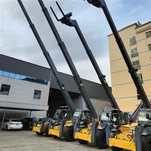
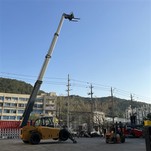
Since container forklifts are mainly used for loading and unloading operations, the following requirements should be met in terms of structural design and performance parameters:
1. The lifting height is determined by the number of layers of stacked containers, and a certain working safety gap should be left.
2. In order to maintain a good operating line of sight, the cab seat should have a height adjustment function.
3. The lifting weight is consistent with the total mass of various types of boxes. For forklifts that only use forks, their lifting weight is equal to the total mass of the container; for forklifts that use top lifting slings, their lifting weight is equal to the total mass of the container plus the mass of the sling.
4. The load center distance is 1/2 of the container width.
5. In order to facilitate alignment with the lock hole of the container corner fittings or the fork slot at the bottom of the box, the fork frame should consider the side shift function and the swing function in the horizontal plane when designing. The range is usually designed as: left and right side shift is between 200mm and 300mm; left and right swing angle is between 3° and 10°.
6. In order to expand the operating range, most heavy-duty container forklifts should be equipped with special lifting equipment.