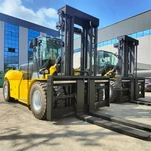
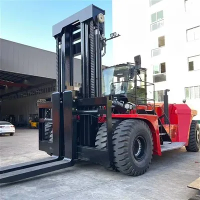
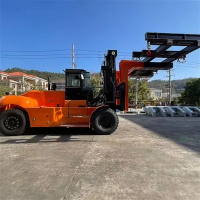
Many fleet managers and facility operators attempt to stretch their capital budgets by forcing standard 10-ton forklifts to lift 12 to 15-ton steel coils or heavy industrial dies. They justify this practice by pointing to narrow warehouse aisles that supposedly cannot accommodate larger machines. This operational decision is not a cost-saving measure; it is a mechanical failure waiting to happen. Pushing equipment past its engineered physical limits guarantees catastrophic component breakdown.
How Excessive Weight Destroys Powershift Transmissions
A heavy-duty forklift's engine is not rigidly coupled to the drive wheels. When an operator ignores the designated forklift load capacity and attempts a static start with a severely overloaded carriage, the physical resistance from the dead weight transfers directly back into the drivetrain. The engine RPM spikes to generate power, but the drive axle remains stationary under the massive load.
The resulting mechanical stress concentrates entirely within the torque converter and the powershift transmission. This extreme internal friction causes transmission fluid temperatures to exceed safe operational limits in a matter of minutes. The intense heat degrades rubber seals and physically burns the clutch friction plates. Saving a fraction of your budget by purchasing a lighter chassis ultimately results in thousands of dollars in transmission replacement costs and severe operational downtime.
The Liability Risk of Ignoring the Load Chart
Every piece of heavy machinery ships with a factory-certified load chart based on precise geometric and metallurgical calculations. This chart dictates the absolute maximum weight the mast channels and chassis can handle at specific load centers.
When a machine lifts a load heavy enough to lift the rear steering tires off the concrete, or cause permanent forward deflection in the mast steel, it crosses from a maintenance issue into a severe legal liability. If an overloaded mast fails or the machine tips, insurance investigators will immediately examine the operational history and load charts. Exceeding the manufacturer's load limits voids warranties and exposes business owners to severe financial and legal penalties in the event of property damage or operator injury.
Upgrading to a 16-Ton Compact Chassis
We understand that physical space constraints often prevent the adoption of standard large-capacity machines. A traditional 16-ton forklift has a long wheelbase and a wide turning radius, making it nearly impossible to navigate older industrial facilities or tight yard layouts.
However, you do not have to compromise on safety to fit your aisles. We engineered a specific chassis to resolve this exact conflict: a 16-ton machine built on a highly compressed footprint. By utilizing high-density cast counterweights and a shortened heavy-duty wheelbase, we deliver true compact heavy duty material handling. This equipment provides the physical stability and heavy-duty Carraro or Kessler drive axle of a 16-ton machine, but with a turning radius that rivals standard 10-ton equipment. You can maneuver through restricted warehouse aisles without violating safety regulations or destroying your transmission.
Stop gambling with inadequate equipment. Send us your maximum payload dimensions and facility aisle widths today for a precise, engineering-backed equipment evaluation.