


Hoisting a 4-ton precast concrete slab or massive steel structure to a 14-meter height is an operation that heavily tests physical limits. At this extreme elevation, minor ground irregularities are brutally magnified. Even a two- or three-degree incline at the tires translates to a lateral shift of several dozen centimeters at the top of the mast. Once the load's center of gravity shifts outside the chassis's safe projection area, a rollover occurs in a fraction of a second. For fleet managers, telehandler safety is never guaranteed by operator courage; it relies strictly on the physical rigidity of the steel chassis and uncompromising mechanical fail-safes.
Why 14m Machines Mandate Front Outriggers
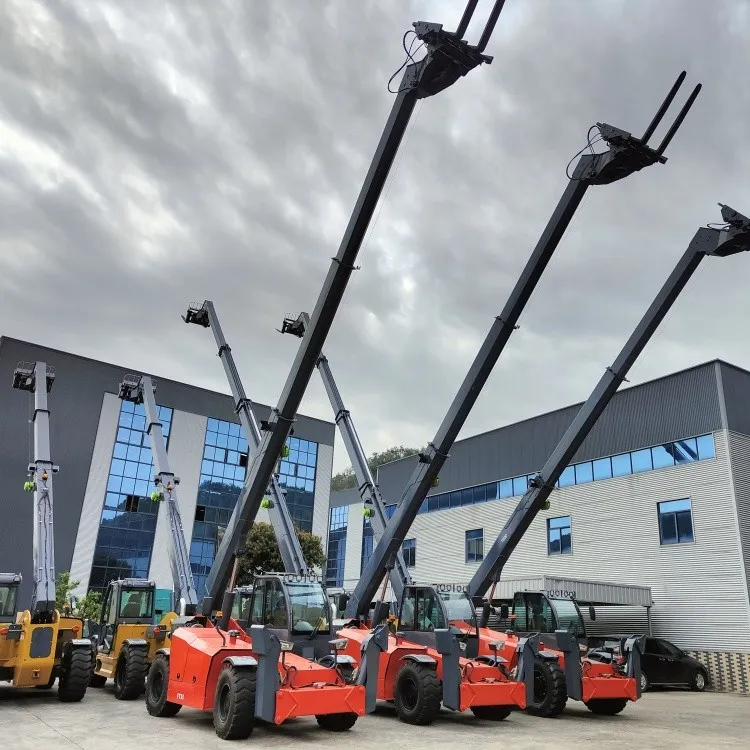
Procurement directors frequently ask why 7-meter telehandlers operate safely without outriggers, while 14-meter units require them as standard equipment. The answer lies in leverage and the exponential growth of the load moment.
For a 7-meter unit, the sheer dead weight of the machine and its wide wheelbase provide enough counterweight to resist forward tipping. However, when the boom extends to 14 meters, the lever arm doubles. Relying solely on the elasticity of pneumatic rubber tires at this height becomes a fatal flaw-even slight tire compression under heavy load induces forward tipping. Front outriggers (stabilizer legs) are a mandatory mechanical redundancy. Once deployed, they bypass the tires entirely, rigidly anchoring the fulcrum point directly into the hard ground. This extends the anti-rollover base forward by nearly a meter, physically locking the chassis and preventing any forward tilt.
Our products
The Mechanics of Hydraulic Frame Leveling
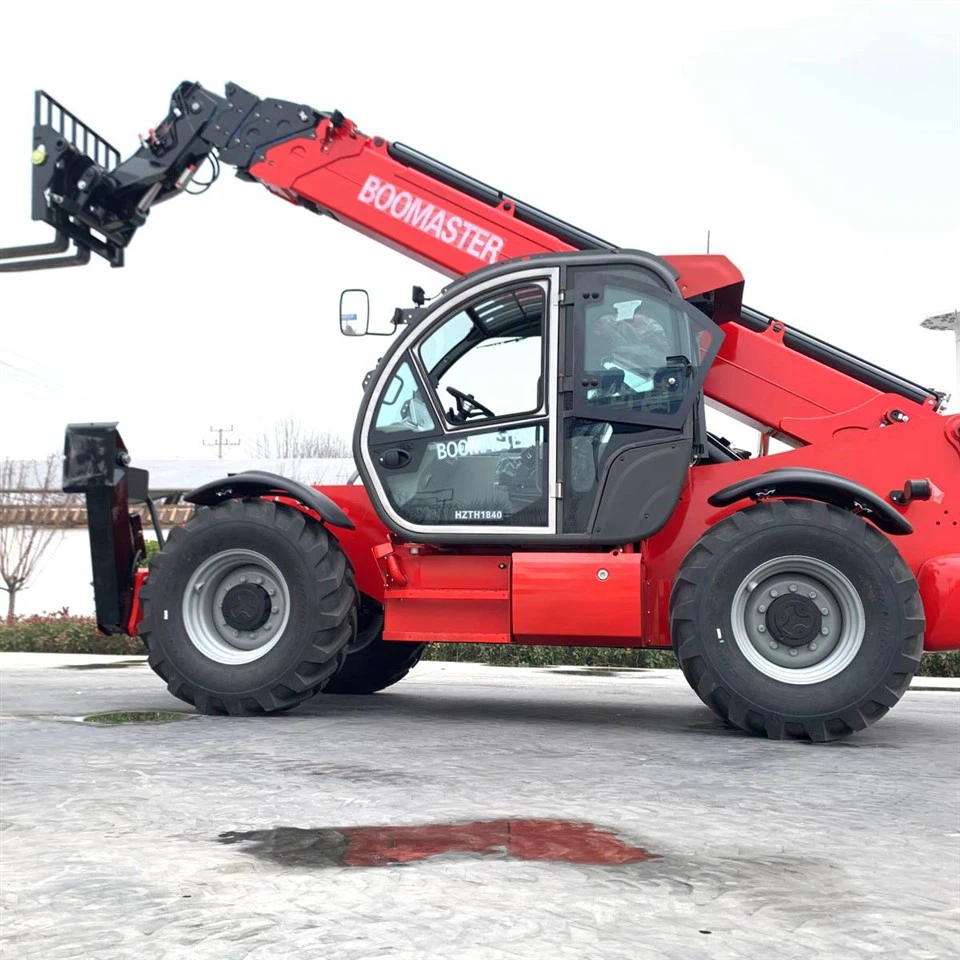
Aside from forward tipping, lateral rollovers are the second largest threat in high-altitude lifting. As a dedicated rough terrain telescopic handler, this equipment rarely operates on perfectly flat concrete. If an operator raises the boom while parked on a slope, the center of gravity immediately shifts downhill, causing immense lateral metal fatigue on the boom channels or an instant rollover.
To counteract this physical reality, professional 14m chassis incorporate a hydraulic frame leveling system. Using large-bore hydraulic cylinders mounted on the axles, operators can independently adjust the chassis tilt by ±9 degrees. This ensures that even if the tires are positioned in deep, uneven mud ruts, the rotational base of the boom remains perfectly horizontal. It directs all gravitational force straight down through the center of the machine, preventing any lateral tearing stress during the lift.
Load Moment Indicators (LMI) Explained
Human error is inevitable, especially when operators attempt to bypass physics to meet tight construction deadlines. To prevent operators from pushing past structural limits at 13.5 or 14 meters, heavy-duty telehandlers integrate a factory-calibrated Load Moment Indicator (LMI) system.
This is not a simple cabin alarm; it is the central safety hub of the chassis. Utilizing pressure sensors on the rear axle and angle/extension sensors on the boom, it calculates the lifting moment in milliseconds. If the payload approaches the absolute limits of the load chart, the LMI does more than flash warnings on the LCD screen-it physically locks out the directional hydraulic valves. The operator is mechanically prevented from executing further "lift" or "extend" commands, allowing only safe retraction movements. This hardcoded intervention completely eliminates the risk of operator overconfidence.
High-altitude operations leave zero room for error. Download our telehandler safety manual and technical whitepaper today to understand how our heavy-duty structures and hydraulic redundancies protect your site and your personnel.


