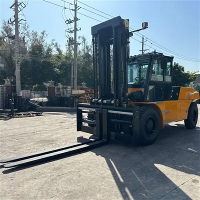
Choose a telehandler from the load weight, required lift height, forward reach and worksite dimensions together. A 2.5 ton machine is often the better choice for tight, low-clearance sites, a 3.5 ton model fits general 7 m handling, and a 4 ton telehandler becomes relevant when the job requires much greater height or forward outreach. Do not choose from rated tonnage alone.
2.5 Ton vs 3.5 Ton vs 4 Ton Telehandler at a Glance
The three capacity classes serve different working envelopes. The largest difference is not the extra 500 or 1,500 kg of nominal load. It is how much height, outreach and machine size the job requires.
| Capacity Class | Rated Load | Typical Xinghao Lift Height | Typical Forward Reach | Best Starting Point |
|---|---|---|---|---|
| 2.5 Ton Compact | 2,500 kg | 5.8–6.0 m class | Approx. 3.1 m | Tight farms, low buildings and confined yards |
| 3.5 Ton | 3,500 kg | 7.0–7.2 m | Approx. 3.8–3.93 m | General construction, agriculture and mixed yards |
| 4 Ton High-Reach | 4,000 kg | 13.5–17.6 m current core range | Approx. 9.1–13.1 m | Elevated placement and long forward outreach |
Choose Capacity from the Actual Working Point
Rated capacity tells you the nominal load class, but it does not tell you how much the machine can carry at maximum height or maximum forward reach.
This becomes increasingly important as the boom gets longer. High-reach 4 ton machines may have much lower residual capacity at the end of their operating envelope.
When a 2.5 Ton Telehandler Is the Better Choice
The 2.5 ton class is not simply a smaller version of a larger telehandler. Compact models are designed around access, turning space and low overall height.
Xinghao's current compact 2.5 ton configuration is rated at 2,500 kg with a 5.8 m lift height and approximately 3.1 m forward reach. Its published overall width is 1,850 mm and cab height is 1,980 mm, making machine dimensions a major part of its selection role.
When a 3.5 Ton Telehandler Fits General Jobsite Work
A 3.5 ton telehandler moves into a broader general-purpose role. The current Xinghao 3.5 ton model is rated at 3,500 kg, reaches approximately 7.2 m vertically and 3.93 m horizontally.
This class is useful when a compact 2.5 ton machine does not provide enough load capacity, but the work does not require a 13 m or 18 m high-reach boom.
When a 4 Ton Telehandler Becomes Necessary
The main reason to move from a 3.5 ton machine to the current 4 ton Xinghao range is usually not the extra 500 kg of nominal capacity. It is the much larger working envelope.
Current 4 ton configurations extend from approximately 13.5 m to 17.6 m of lift height, with forward outreach from roughly 9.1 m to 13.1 m. These machines are therefore aimed at elevated material placement and work beyond obstacles.
More Rated Capacity Does Not Always Mean More Capacity at Reach
A longer boom changes the load geometry. This is why the correct comparison is not simply 2,500 kg versus 3,500 kg versus 4,000 kg.
The 4 ton 17.6 m configuration demonstrates the difference clearly: it is rated at 4,000 kg, but published data lists 2,500 kg at maximum height and only 700 kg at maximum forward reach.
If the load only needs to reach 6–7 m and the site values mobility, there may be no reason to move directly to a much longer 4 ton high-reach platform. The correct model is the smallest machine whose approved working envelope safely contains the required load point.
Worksite Size Can Decide the Capacity Class
A larger telehandler needs more physical space. Before choosing a higher-capacity or longer-boom model, check whether it can reach the load through the actual access route.
2.5 Ton, 3.5 Ton or 4 Ton for Agriculture?
2.5 Ton
Start here when barn height, narrow access, greenhouse lanes or tight farm yards are the main constraints.
3.5 Ton
Better suited to heavier bale, pallet and loading work where approximately 7 m of reach is sufficient.
4 Ton
Consider a high-reach 4 ton platform when material must be placed much higher or beyond significant obstacles.
2.5 Ton, 3.5 Ton or 4 Ton for Construction?
| Job Requirement | Capacity Class to Compare First | Reason |
|---|---|---|
| Tight urban jobsite | 2.5 Ton Compact | Smaller access envelope and compact chassis |
| General pallet placement to 6–7 m | 3.5 Ton | Balance of capacity, height and mobility |
| Material placement above 10 m or beyond obstacles | 4 Ton High-Reach | Much larger vertical and horizontal working envelope |
Attachment Choice Can Change the Required Telehandler Size
Pallet forks, buckets, clamps, lifting hooks and other attachments change the machine's working condition. Attachment weight and geometry can reduce the capacity available for the actual payload.
A job that appears to require a 2.5 ton telehandler from payload weight alone may need a larger machine once the attachment, load center and boom position are included.
A Simple Capacity Selection Method
What Information Should You Send for a Capacity Recommendation?
Compare Current Xinghao Telehandler Classes
Telehandler Capacity FAQ
Get a Telehandler Capacity Recommendation
Send the maximum load weight and dimensions, required lift height, forward reach, attachment, access width and height, terrain, gradients, quantity and destination. Xinghao can compare the 2.5 ton, 3.5 ton and 4 ton classes against the actual working point before model selection.