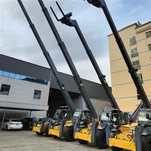
The working principle of warehouse forklift mainly includes the following aspects:
Power system: Warehouse forklift is usually driven by electric motor, which has the characteristics of compact body, flexible movement, light weight and good environmental performance. Warehouse forklift driven by electric motor needs to be supported by backup battery when working in multiple shifts.
Steering technology: Three-way forklift uses special steering mechanism, hydraulic or electric control to rotate the wheels 90 degrees to achieve right-angle steering. This design is extremely practical in narrow passages and can improve space utilization and work efficiency.
Unmanned forklift: In the field of intelligent warehousing, unmanned forklift completes the work through key steps such as path planning, autonomous navigation, automatic control and cargo handling. Unmanned forklift uses technologies such as laser navigation, camera navigation or ultrasonic navigation to collect environmental information in real time, realize autonomous navigation and precise control.
Electric pallet handling forklift and electric pallet stacking forklift: These two types of forklifts play an important role in warehouse operations. Electric pallet trucks are suitable for daily cargo handling, with a load capacity of 1.6 to 3.0 tons and a fork lift height of about 210mm. Electric pallet stacking trucks are used for stacking high-rise cargo, with a fork lift height of more than 300mm and a load capacity of 1.0 to 1.6 tons.
Reach trucks : Reach trucks have forks that move forward and backward independently of the vehicle body, which are suitable for working in narrow passages and limited spaces, improving work efficiency and flexibility.