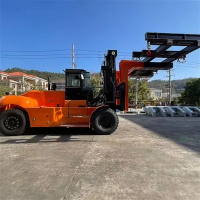
If you manage a port terminal, an inland logistics hub, or a railway freight yard, you know that space and time are your two most expensive assets. When it comes time to expand your fleet for container handling, the biggest capital expenditure (Capex) decision usually comes down to one classic debate: the reach stacker vs forklift.
Both machines are designed to lift massive steel boxes, but they approach the job very differently. Making the wrong choice can lead to a congested yard, wasted land, or unnecessary equipment debt. Let's break down the realities of both machines so you can make the most profitable decision for your terminal.
The Advantages of a Reach Stacker: Maximum Stacking and Flexibility
When yard space is tight and land is expensive, the reach stacker is the undisputed king of density.
Unlike a standard mast forklift that only lifts straight up, a reach stacker uses a telescopic boom. This design allows the operator to reach over the first row of containers to pick up a box in the second, or even third, row.
If you are dealing with fully loaded 20ft or 40ft boxes, a standard 45 ton reach stacker allows your yard planners to stack containers up to five or six high in the first row, and four high in the second row. Furthermore, the spreader attachment can rotate the container, which is incredibly useful for loading railcars or maneuvering through narrow terminal aisles without needing to turn the entire machine around. The result? You can store significantly more TEUs (Twenty-foot Equivalent Units) per square meter of yard space.
The Advantages of a Heavy Duty Container Forklift: Lower Cost, Simple Maintenance
So, if reach stackers are so capable, why do so many terminals still buy traditional heavy-duty container forklifts? The answer is simple: upfront cost and mechanical reliability.
A heavy-duty forklift (often equipped with a top-lift spreader) can only access the container directly in front of it. You lose the second-row reach, which means your yard aisles need to be wider and your stacks shallower.
However, the purchase price of a container forklift is substantially lower than a reach stacker. Additionally, the maintenance is far more straightforward. A forklift relies on a traditional mast and standard hydraulics. Any experienced heavy diesel mechanic can service it. There are fewer complex electronic sensors and boom mechanics to fail in harsh, salty coastal environments, translating to higher overall uptime.
(Note: If your yard primarily stores unladen boxes, you don't even need top-tier lifting capacity. A dedicated empty container handler-a specialized high-mast forklift-is the most cost-effective way to stack empty boxes up to eight high.)


ROI Calculation: Let Your Container Throughput Decide
Don't overbuy equipment you won't fully utilize, and don't underbuy if it creates a bottleneck. Here is how fleet managers calculate the ROI:
- When to buy the Forklift: If your terminal handles low to medium throughput, or if you operate an inland yard where land is relatively cheap and abundant, the traditional heavy-duty forklift wins. The lower initial Capex and cheaper maintenance parts will keep your Total Cost of Ownership (TCO) low.
- When to buy the Reach Stacker: If your terminal is landlocked, heavily congested, and handles a high volume of TEUs daily, the reach stacker is a mandatory investment. The premium you pay for the machine is quickly offset by the massive increase in yard storage density and faster train/truck turnaround times.
Xinghao Port Machinery: Your One-Stop Procurement Solution
Managing a mixed fleet of port equipment can be a nightmare for your parts inventory and procurement team. Whether you are outfitting a newly built terminal or upgrading an aging fleet, Xinghao Forklift provides a factory-direct solution.
As a leading heavy equipment manufacturer in China, we produce the full spectrum of port machinery. From 16-ton to 52-ton heavy diesel forklifts, to specialized empty handlers and top-tier 45-ton reach stackers, we supply it all.
For overseas equipment dealers and large terminal operators, we offer mixed-fleet package deals and full OEM customization. Sourcing your heavy lifters from a single, reliable Chinese factory ensures standardized parts, simplified warranty claims, and wholesale pricing that protects your margins.
Evaluate your yard's throughput today. Contact the Xinghao engineering team to compare factory-direct prices and lead times for both our reach stackers and heavy-duty container forklifts.