


What Is a Reach Stacker
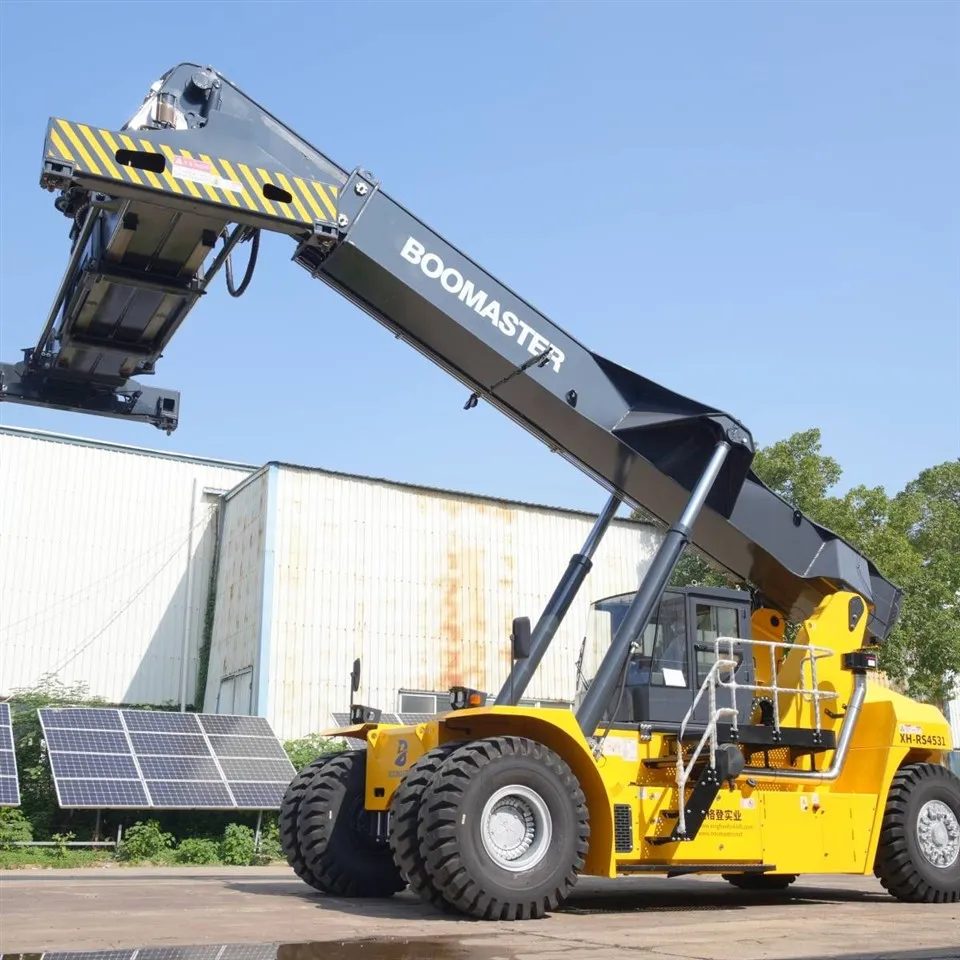
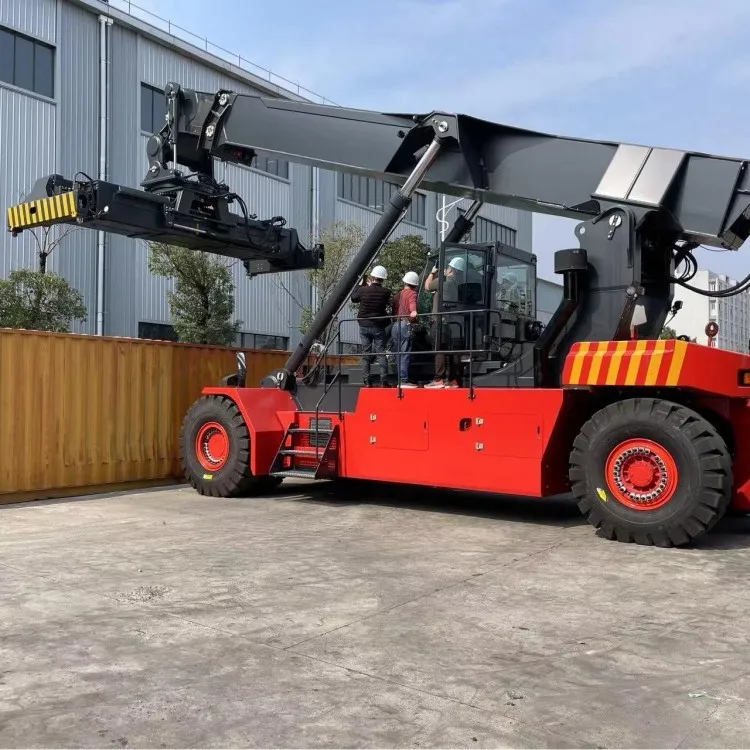
A reach stacker is a specialized piece of heavy-duty container handling equipment designed for lifting, moving, and stacking shipping containers in ports, terminals, and industrial yards.
Unlike standard forklifts, a reach stacker uses a telescopic boom with a spreader to handle containers. This allows it to stack containers in multiple rows and heights (typically 3–5 high), while maintaining flexibility in tight yard environments.
In practical terms: A forklift moves cargo, but a reach stacker manages container flow.
How a Reach Stacker Works

A reach stacker operates through a combination of hydraulic systems and mechanical structures:
Main Components:
- Telescopic boom
- Container spreader (with twistlocks)
- Hydraulic lifting system
- Heavy-duty chassis and counterweight
Basic Working Process:
- The machine approaches the container
- The boom extends forward
- The spreader locks onto the container corners
- The container is lifted and retracted
- The operator moves and stacks it in position
This "extend–lock–lift–retract" sequence is what gives the machine its name and capability.
Key Technical Considerations:
Professional buyers should focus on:
- Load chart performance (capacity at different reach distances)
- Hydraulic response speed (affects cycle time)
- Machine stability under load
- Engine torque at low RPM (critical for heavy lifting)
Where Reach Stackers Are Used

1. Ports and Container Terminals
This is the primary application.
Used for:
- Container loading and unloading
- Yard stacking and reshuffling
- Short-distance transport
Key requirement:
- High efficiency under continuous operation
2. Rail Terminals / Inland Container Depots (ICD)
Reach stackers are widely used for:
- Rail-to-yard transfer
- Truck-to-rail operations
Advantages:
- No fixed infrastructure required
- High flexibility for changing layouts
3. Container Yards and Logistics Hubs
Ideal for:
- Inland logistics parks
- Temporary container storage yards
- Medium-scale terminals
They allow:
- Multi-row stacking
- Fast repositioning
- Lower infrastructure investment
4. Industrial Applications
Increasingly used in industries such as:
- Steel plants
- Stone and granite yards
- Heavy equipment manufacturing
Typical use:
- Container loading/unloading within factory logistics
Key Advantages of Reach Stackers

High Flexibility
No rails or fixed systems required. Easily adapts to changing yard layouts.
Strong Stacking Capability
- First row: full capacity
- Second row: reduced capacity
- Third row: light or empty containers
This multi-row capability is a major advantage over forklifts.
Lower Initial Investment
Compared to RTG or RMG cranes:
- Lower purchase cost
- Faster deployment
- Suitable for developing markets
Adaptability to Harsh Conditions
Works well in:
- Uneven ground conditions
- Outdoor heavy-duty environments
- Mixed cargo operations
Reach Stacker vs Other Equipment
Reach Stacker vs Heavy Forklift
| Factor | Reach Stacker | Heavy Forklift |
|---|---|---|
| Main Use | Containers | General cargo |
| Stacking | Multi-row | Single row |
| Flexibility | High | Medium |
| Application | Ports, yards | Factories |
If your operation is container-based, a forklift is not a substitute.

Reach Stacker vs Empty Container Handler (ECH)
| Factor | Reach Stacker | ECH |
|---|---|---|
| Load Type | Full & empty containers | Empty containers only |
| Cost | Higher | Lower |
| Speed | Moderate | Faster |
| Application | Mixed operations | Dedicated empty yards |
Choose reach stacker for versatility, ECH for specialized empty handling.


Reach Stacker vs Gantry Crane (RTG/RMG)
| Factor | Reach Stacker | Gantry Crane |
|---|---|---|
| Investment | Lower | Higher |
| Mobility | High | Fixed |
| Automation | Low | High |
| Best For | Medium yards | Large terminals |
Reach stackers are ideal for growing operations and flexible layouts.
Final Thoughts for Buyers
A reach stacker is often the most practical solution when your operation involves:
- Container handling
- Yard stacking
- Flexible logistics environments
However, the right configuration depends on your actual working conditions.
Before purchasing, consider:
- Container type (20ft / 40ft / loaded / empty)
- Required stacking height
- Yard layout and space constraints
- Operating intensity (hours per day)
- Maintenance and parts availability
Need Help Choosing the Right Model?
If you're evaluating a reach stacker or container handling equipment, it's important to match the machine to your real working conditions-not just the rated capacity.
You can provide:
- Container type and weight
- Stacking requirements
- Yard dimensions
- Application scenario
Based on this, a more accurate configuration and model recommendation can be made to ensure long-term efficiency and return on investment.


