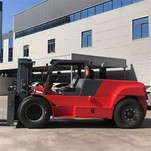
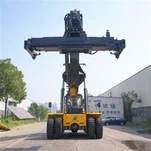
Handling raw timber introduces extreme, shifting Load Centers that threaten chassis stability and mast rigidity during high-speed transport. Deploying purpose-built logging material handling equipment equipped with hydraulic accumulators and wide carriages neutralizes destructive kinetic energy, preventing structural failure and ensuring a predictable TCO across rugged forestry operations.
Absorbing Kinetic Energy: Hydraulic Accumulators
Transporting massive, irregular logs across unpaved forestry terrain generates severe mechanical shockwaves. When a forklift hits a rut at speed, the heavy timber transfers immense kinetic energy directly into the mast rollers and hydraulic tilt cylinders. To prevent metal fatigue and blown cylinder seals, engineers integrate nitrogen-charged hydraulic accumulators into the lifting circuit. These accumulators act as active physical springs, compressing to absorb pressure spikes and dampening the destructive impact energy before it reaches the core chassis. This mechanical isolation drastically lowers maintenance Opex and maximizes continuous fleet uptime.
Articulated Log Grapples and Wide Carriages
Raw timber lacks a uniform center of gravity. Standard forks are inadequate for securing cylindrical, shifting loads. A dedicated timber forklift must utilize ultra-wide carriages paired with articulated hydraulic log grapples. This configuration creates a mechanical closed-loop clamping force. The widened carriage distributes the lateral load across a larger mast surface area, resisting torsional stress when logs shift dynamically during transit. Concurrently, the dual hydraulic cylinders of the grapple maintain constant, active downward pressure, physically locking the timber against the carriage to prevent dangerous load slippage and material loss.
Wet Multi-Disc Brakes for Downhill Timber Transport
Navigating steep downhill gradients with a maximum timber payload pushes standard drum brakes past their thermal limits, leading to instantaneous friction fade. In heavy logging applications, relying on exposed braking components is a direct threat to operator safety and Capex preservation. We mandate the use of enclosed Wet Multi-Disc Brakes combined with Limited Slip Differentials for maximum off-road control. Submerged in a continuous oil bath, this braking architecture actively dissipates extreme heat generated during heavy deceleration. The sealed housing prevents abrasive mud and debris from contaminating the friction plates, securing reliable, fade-free stopping power and drastically reducing brake replacement frequency.
| Forestry Specification | Standard Yard Forklift | Xinghao 4WD Timber Forklift | Operational / TCO Impact |
| Shock Absorption | Rigid Hydraulic Cylinders | Nitrogen Hydraulic Accumulators | Prevents mast fatigue; lowers hydraulic repair Opex |
| Load Securing | Standard Forks | Wide Carriage & Hydraulic Grapple | Eliminates timber slippage; maximizes handling safety |
| Braking Architecture | Exposed Dry Drum Brakes | Enclosed Wet-Disc Brakes | Zero friction fade on steep downhill gradients |
| Torsional Rigidity | Narrow Carriage | Widened, Reinforced Carriage | Resists lateral stress from shifting Load Centers |
| Overall Fleet ROI | High downtime, frequent repairs | Continuous high-throughput logging | Fast Capex recovery in rugged environments |
Frequently Asked Questions (FAQ)
Q: How do hydraulic accumulators protect the mast during timber transport?
A: Nitrogen-charged accumulators absorb the sudden pressure spikes generated when carrying heavy timber over rough terrain. By acting as a hydraulic shock absorber, they prevent this kinetic energy from fracturing mast welds or blowing cylinder seals, significantly reducing maintenance Opex.
Q: Why is a standard fork carriage insufficient for logging operations?
A: Standard carriages are too narrow to control the dynamic, shifting Load Center of long timber. A widened carriage combined with a hydraulic log grapple distributes the torsional stress and provides a continuous mechanical clamping force, physically securing the irregular payload.
Q: Are enclosed wet-disc brakes necessary for off-road forestry?
A: Yes. Standard dry brakes suffer from rapid thermal fade under heavy downhill deceleration and are easily destroyed by abrasive mud. Enclosed wet-disc brakes operate in a sealed oil bath, guaranteeing consistent heat dissipation, zero debris contamination, and reliable stopping power.
Contact our heavy machinery export team today to request complete factory-direct pricing for our 4WD rough terrain forklifts. Submit your maximum timber dimensions and required gradients to receive a customized hydraulic log grapple configuration and a full TCO calculation sheet for your logging operations.