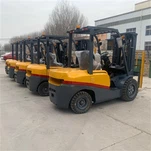
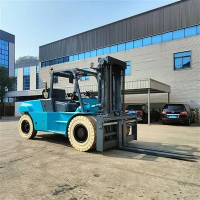
There is no universal "best" telehandler engine. Cummins, Perkins and Yuchai can all be suitable choices when the exact engine model matches the machine duty, destination-market emission requirement and local service environment. Before selecting an engine, compare rated power, torque characteristics, approved emission configuration, local parts access and the complete telehandler specification.
Why the Telehandler Engine Matters
The engine does more than move the telehandler across the jobsite. It supplies the power needed for travel, climbing, hydraulic operation and repeated boom cycles under changing terrain and load conditions.
However, engine brand alone does not determine lifting capacity. The boom structure, load chart, hydraulic system, transmission, axle, tires and machine geometry remain separate parts of the telehandler's approved working envelope.
Cummins vs Perkins vs Yuchai Telehandler Engines
The table below is a procurement comparison, not a universal ranking. Exact power, torque and emission level depend on the engine model fitted to the selected telehandler.
| Buying Factor | Cummins | Perkins | Yuchai |
|---|---|---|---|
| Xinghao Telehandler Examples | 3.5T, 5T/10m, 10T and other configurations | Available on selected 3.5T / 7m configuration | Used on selected 3.5T / 7m and 4T-class machines |
| Best Comparison Method | Exact engine model + local support | Exact engine model + local support | Exact engine model + local support |
| Emission Selection | Confirm model and destination standard | Confirm model and destination standard | Confirm model and destination standard |
| Parts Decision | Check local filters, sensors and engine service | Check local filters, sensors and engine service | Check local filters, sensors and engine service |
| Final Decision | Market + telehandler configuration | Market + telehandler configuration | Market + telehandler configuration |
When a Cummins Telehandler Engine Makes Sense
Cummins engines appear across several current Xinghao telehandler configurations. For example, the 3.5 ton telehandler lists a QSB3.9-C100-30 rated at 74 kW, while the 5 ton 10 m T5010 uses a QSB3.9-C125-30 rated at 81 kW with a 480 N·m torque reference.
The 10 ton telehandler moves into a larger QSB4.5 configuration rated at 97 kW. This illustrates an important buying rule: the word "Cummins" is not itself a specification. Engine model, rated output and the complete machine duty must still be matched.
When to Consider a Perkins Telehandler Engine
Selected Xinghao 3.5 ton 7 m telescopic handler configurations list Perkins or Cummins turbocharged diesel power. This makes Perkins relevant where the final telehandler build is approved around that engine and the buyer has suitable local support.
The correct comparison is not "Perkins versus Cummins in general." It is the exact Perkins engine offered on the machine versus the exact alternative engine, including power, emission package, cooling arrangement, service items and local technical support.
When a Yuchai Telehandler Engine Fits the Project
Xinghao's current 7 m heavy-duty telescopic handler lists the Yuchai YC4DK100-T304 with approximately 73–73.5 kW rated output. Other telehandler pages also list Yuchai alongside Cummins as an engine option.
Buyers should treat Yuchai in exactly the same engineering way as any other engine brand: confirm the exact model, power rating, emission package, local service support and compatibility with the ordered telehandler.
More Kilowatts Do Not Automatically Mean a Better Telehandler
A higher engine power figure is useful only when it belongs to a machine designed to use that output. Telehandler performance is shared across the engine, transmission or hydrostatic drive, hydraulic pump, axles, tires and boom system.
A 74 kW engine on a 3.5 ton 7 m machine and a 97 kW engine on a 10 ton machine cannot be compared by power alone because the machines have very different weight, boom geometry and duty requirements.
| Xinghao Example | Engine | Rated Power | Machine Duty |
|---|---|---|---|
| 3.5 Ton Telehandler | Cummins QSB3.9-C100-30 | 74 kW | 7.2 m general reach class |
| 5 Ton 10 m T5010 | Cummins QSB3.9-C125-30 | 81 kW | 5 t / 10 m class |
| 10 Ton Telehandler | Cummins QSB4.5 | 97 kW | 10 t / 9.6 m heavy class |
| 7 m Heavy Duty Telehandler | Yuchai YC4DK100-T304 | Approx. 73–73.5 kW | 3.5 t / 7 m class |
Match the Engine to the Destination-Market Emission Requirement
Engine brand does not define the emission level. One manufacturer may offer multiple engine families and market-specific configurations. The engine code and its documentation must be checked against the destination requirement.
Buyers should state the destination country in the RFQ and avoid using terms such as "Euro 5," "Stage V" or "EPA" interchangeably. These are different regulatory frameworks and should be verified separately.
Local Parts Availability Can Matter More Than Brand Preference
A familiar engine brand can be attractive, but the practical question is whether the exact engine model can be supported where the telehandler will work.
Before ordering, ask the local service provider or distributor about routine filters, belts, sensors, electrical components, diagnostic access and technician experience for the exact engine code. Do not assume that brand presence in a country means every industrial engine model has the same support coverage.
Which Engine Fits Your Market?
Choose from Local Support First
If multiple approved engine configurations meet the telehandler duty, compare local parts, technicians and diagnostic support in the destination country.
Choose from Emission Requirements
A preferred engine brand is not useful if the offered configuration cannot satisfy the destination's required emission documentation.
Choose from Machine Duty
Engine selection must stay tied to the actual telehandler model, capacity, lift height, hydraulic demand and terrain.
Seven Questions to Ask before Approving a Telehandler Engine
Three Engine-Selection Mistakes to Avoid
Compare Telehandler Powertrain Configurations
Telehandler Engine FAQ
Ask Which Engine Fits Your Market
Send the required telehandler capacity, lift height, forward reach, attachment, terrain, maximum gradient, daily operating hours, destination country and required emission standard. Xinghao can compare the available engine configurations for the selected telehandler and confirm the powertrain on the final technical quotation.