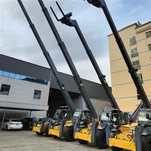
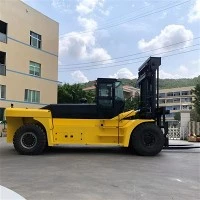
The pneumatic tire electric counterbalance forklift combines a battery-electric drive system with a four-wheel counterbalanced chassis and pneumatic tires. It is built for material handling operations that move continuously between indoor warehouses, production floors, loading docks, and paved outdoor yards.
Compared with cushion or solid-tire electric forklifts, pneumatic tires deliver greater tire deflection on uneven paved surfaces, improving travel stability across mixed indoor and outdoor routes. Compared with internal combustion models, the electric powertrain eliminates tailpipe emissions at the point of use and significantly reduces engine-related maintenance requirements.
Selecting the right machine requires evaluating rated capacity, load center, lift height, operating hours, floor conditions, outdoor travel frequency, and charging availability.
Key Specifications
|
Specification |
Typical Configuration |
|
Rated Capacity |
1,500–3,500 kg |
|
Load Center |
500 mm standard |
|
Standard Lift Height |
3,000 mm |
|
Maximum Lift Height |
Configuration dependent |
|
Drive System |
AC electric drive |
|
Battery Voltage |
48 V / 80 V, model dependent |
|
Tire Type |
Pneumatic |
|
Fork Length |
1,070 mm standard on selected models |
|
Fork Tilt |
Approx. 6° forward / 12° backward |
|
Travel Speed |
Model dependent |
|
Gradeability |
Model dependent |
|
Mast Configuration |
Duplex / Triplex options |
|
Attachments |
Side shifter, fork positioner and other options |
|
Charger |
Matched to battery and local power supply |
Typical Applications
Manufacturing
Transferring raw materials, components, and finished assemblies between indoor production bays and paved outdoor yards.
Building Materials
Handling bricks, tiles, and packaged supplies across mixed yard surfaces and warehouse floors.
Logistics & Freight
Executing direct pallet handling in shipping yards without requiring specialized loading ramps.
Battery Selection Criteria
Battery selection must be matched to the actual duty cycle rather than estimated runtime.
Before confirming an order, evaluate:
Operating hours per shift
Number of shifts per day
Average load percentage
Travel distance per cycle
Lifting frequency
Available charging windows
Ambient operating temperature
Local electrical supply specifications
Rated Capacity Is Not the Only Selection Number
A forklift labeled with a 3,000 kg capacity does not lift 3,000 kg at every load geometry and lift height combination.
Rated capacity is determined by evaluating multiple variables simultaneously:
Load weight and center of gravity
Mast configuration and collapsed height
Maximum lift height
Fitted hydraulic attachments
Load dimensions and physical stability
For standard palletized loads, a 500 mm load center is standard in this capacity class.
Load Moment Example: If a load exceeds the standard load-center distance, the load moment increases proportionally. Selection must be based on actual pallet dimensions rather than nominal machine capacity. Submit load weight, dimensions, load center, and lift height during the RFQ stage to verify capacity retention.
Mast and Fork Configuration
Matching the correct mast ensures proper clearance and stacking height.
Duplex Mast: Suited for general warehouse handling, truck loading, standard pallet stacking, and operations with moderate overhead clearance limits.
Triplex Mast: Utilized where higher stacking is required within buildings featuring restricted ceiling heights, or where free-lift capability is necessary to enter low-clearance trailers and containers.
Masts must be selected by reviewing maximum fork height, free lift, collapsed mast height, and overhead guard dimensions concurrently.
Battery and Charging Selection
Battery configuration dictates daily operational uptime. Selecting the correct power source requires balancing shift duration, workload intensity, and charging infrastructure.
Lead-Acid Batteries: A practical choice for predictable single or double-shift operations with dedicated charging rooms, structured cooling periods, and established maintenance routines.
Lithium-Ion Batteries: Ideal for operations requiring opportunity charging during breaks, elimination of daily battery maintenance, multi-shift scheduling, and strict runtime optimization.
The battery, charger, battery management system (BMS), and vehicle electrical architecture must be specified as a unified power system.
Pneumatic Tire Selection Guide
Tire choice directly influences stability, traction, and floor protection.
Pneumatic Tires: Recommended for paved outdoor yards, loading docks, mixed indoor-outdoor routines, and slightly uneven concrete surfaces where cushioning is required.
Solid / Cushion Tires: Appropriate for smooth indoor floors and controlled warehouse environments where puncture resistance and tight turning clearances are top priorities.
Rough-Terrain Tires: Required when working surfaces feature loose soil, deep gravel, mud, severe slopes, or unpaved industrial sites.
FAQ
Q: Is a pneumatic tire electric forklift suitable for outdoor use?
A: Yes. Pneumatic tires give this forklift better traction and shock absorption on paved outdoor yards and mixed indoor-outdoor routes compared to standard cushion-tire warehouse models. It is not designed to replace a four-wheel-drive rough-terrain machine on unpaved mud or deep gravel.
Q: What is the standard load center?
A: A 500 mm load center serves as the baseline for standard capacity ratings in the 2.5 to 3.5 ton range. Actual lifting capacity must be validated against specific load dimensions, mast heights, and attachment selections.
Q: Can the forklift operate on a lithium battery system?
A: Yes. Lithium configurations are available across selected models. System voltage, battery capacity, and charging units must be specified based on shift length and regional electrical supply.
Q: Can the forklift navigate workplace ramps?
A: Yes, provided the ramp gradient is within the machine's rated gradeability limits. Selection must account for load weight, ramp steepness, surface traction, and travel distance.
Q: Can an electric model replace a diesel forklift?
A: For many paved indoor and outdoor operations, an electric pneumatic tire forklift replaces internal combustion units cleanly. For continuous heavy-duty outdoor work over rough surfaces without charging infrastructure, an internal combustion or rough-terrain model remains preferable.
Q: Can hydraulic attachments be integrated?
A: Yes. Side shifters, fork positioners, and clamps can be integrated. The added weight and forward center of gravity of any attachment must be factored into the final capacity calculation.
Hot Tags: pneumatic tire electric counterbalance forklift, China pneumatic tire electric counterbalance forklift suppliers, factory, 2 5 Ton 7m Height Telescopic Handlers Forklift, 2 5 ton lead acid electric forklift, 3t forklift truck, 4 Ton Electric Forklift Truck, 4t electric counterbalanced forklift truck, electric counterbalanced forklift truck 8t