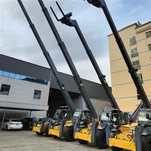
The main purpose of the container reach crane (reach stacker) is to load, unload and stack containers, and transport them horizontally at the dock or yard. Its core functions and application scenarios can be summarized as follows:
Loading and stacking
Designed for 20-foot and 40-foot international containers, it uses telescopic arms and spreaders to complete the grabbing, lifting and stacking of containers.
Supports cross-container operations, high flexibility, and can directly cross other containers for multi-layer stacking (up to 5-6 layers), significantly improving the utilization rate of the yard.
Horizontal transportation
It undertakes the task of short-distance transportation of containers within the dock and yard, replacing traditional forklifts, and has both mobility and stability.
Applicable scenarios
Small and medium-sized ports: Due to its convenient operation and strong site adaptability, it has become the main equipment of small and medium-sized ports.
Transit station: Widely used for container loading and unloading operations at railway and highway stations.
Large terminal auxiliary: As a supplementary equipment in large container terminals, it handles the loading and unloading needs of specific areas.
Advantages Comparison
Compared to forklifts, reach stackers have the following advantages:
Higher stacking capacity (forklifts usually only stack 2-3 layers);
Lower wheel pressure, reducing the requirements for ground bearing capacity;
The hoist can rotate and move left and right to improve the efficiency of box handling.