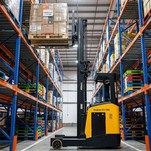
Light-duty indoor warehouse forklifts operate perfectly fine on standard 48V or 80V electrical architectures. However, when fleet managers attempt to scale that same low-voltage platform up to a heavy-duty chassis, they run directly into the uncompromising laws of thermodynamics. Lifting 10,000 kg of structural steel or industrial molds requires massive bursts of mechanical power. Attempting to pull that power through an 80V system crosses a dangerous threshold, risking severe overheating, degraded lifting performance, and component failure. To physically survive the demands of heavy industrial yards, a true heavy-duty electric forklift must be built on a 614V high-voltage platform.
Ampere Draw and Cable Thermal Management
The mechanical limitation of a low-voltage system in heavy equipment comes down to basic electrical physics. Power requirements dictate that to maintain the same wattage output, any drop in voltage requires a proportional, massive increase in electrical current (Amperage).
If a heavy forklift requires 120 kW of peak power to hoist a fully loaded carriage, an 80V system must pull an immense 1,500 amperes of continuous current. This extreme amperage generates intense electrical resistance, effectively turning the copper wiring harnesses and controller boards into thermal heating elements. To prevent the cables from literally melting, low-voltage machines require impractically thick, rigid copper routing and aggressive cooling.
By upgrading the architecture to a 614V system, that same 120 kW power demand only draws around 195 amperes. This drastic reduction in current physically eliminates the massive heat generation. The cables remain cool under continuous load, thermal throttling is bypassed, and the dual drive motors receive stable, uninterrupted power during maximum-capacity lifts.
Achieving 100% Charge in 2 Hours with DC Fast Charging
Heavy manufacturing and logistics operate on three-shift, 24/7 schedules. A machine that needs to sit idle for eight hours to charge and cool off is a mathematical liability to your fleet's Total Cost of Ownership (TCO). High-voltage platforms resolve this downtime through direct current (DC) input.
Because 614V systems are built with advanced thermal management, they can safely accept massive electrical inputs. By connecting the machine to commercial DC fast charging port equipment (such as a 240kW or 320kW dual-gun terminal), operators can drive the battery from 20% to 100% capacity in less than two hours. More importantly, this enables "opportunity charging." Operators can plug the machine in during a 45-minute lunch break or shift handover, injecting enough kilowatt-hours to sustain the next full shift without ever taking the equipment out of active rotation.
LFP Cell Chemistry and Cycle Life Reality
The structural integrity of the battery chemistry is just as critical as the voltage. When procuring a 10 ton lithium forklift, fleet buyers must demand Lithium Iron Phosphate (LFP) cells, specifically those manufactured by Tier 1 suppliers like CATL.
Unlike the NMC (Nickel Manganese Cobalt) batteries found in consumer electronics, LFP chemistry possesses a highly stable covalent bond structure. It is physically highly resistant to thermal runaway, meaning it will not combust even if the casing is punctured on a hazardous job site. Furthermore, real-world stress testing proves that a CATL LFP pack can endure over 4,000 deep charge-discharge cycles while still retaining 80% of its original factory capacity. This translates to a reliable 8 to 10-year physical lifespan in a heavy-duty cycle, far outlasting the rebuild schedule of a traditional diesel engine block.
Stop letting electrical inefficiencies limit your heavy material handling capabilities. Contact our engineering team today to download the complete high-voltage safety protocol and the Xinghao OEM configuration sheet for your next fleet upgrade.