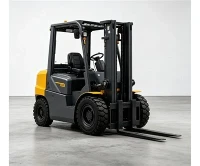
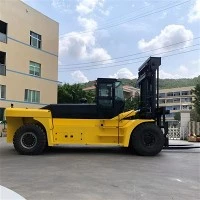
The Electric Sit-Down Pneumatic Tire Forklift combines a battery-electric powertrain, a seated counterbalance layout, and pneumatic tires for material handling environments where standard indoor electric warehouse trucks are insufficient.
This configuration suits loading docks, manufacturing plants, distribution yards, and warehouses with outdoor transfer routes. It provides electric-powered operation alongside the tire compliance and ground clearance required for mixed indoor and outdoor surfaces.
Product Configuration at a Glance
|
Item |
Configuration |
|
Power Source |
Battery-Electric |
|
Operator Type |
Sit-down rider |
|
Chassis Layout |
Counterbalanced |
|
Tire Type |
Pneumatic tires |
|
Drive System |
AC electric drive (model-dependent) |
|
Steering System |
Hydraulic power steering |
|
Mast Options |
2-stage / 3-stage configurations |
|
Battery Options |
Lead-acid or lithium-ion |
|
Common Attachments |
Side shifter, fork positioner |
|
Operating Environment |
Indoor / Outdoor mixed handling (configuration-dependent) |
Where This Forklift Fits
Manufacturing Plants: Transferring raw materials, components, and finished pallets between production lines, assembly areas, and shipping docks.
Distribution Centers: Loading and unloading transport trailers while moving unit loads between dock plates and storage racking.
Building-Material Handling: Transporting packaged construction supplies across concrete yards, loading zones, and uneven surface transitions.
Outdoor Storage Yards: Supporting operations where electric drive is preferred, but travel surfaces extend beyond smooth indoor flooring.
Mixed Logistics Routes: Performing continuous short-distance transfer between separate warehouse buildings across paved outdoor pathways.
When Should You Choose Pneumatic Tires?
Pneumatic tires must be selected based on actual floor, dock, and yard conditions rather than treated as a generic outdoor add-on.
Consider a pneumatic tire electric forklift when your operation includes:
- Outdoor concrete or asphalt travel paths
- Loading docks and inclined dock approaches
- Uneven floor transitions between buildings
- Short outdoor travel cycles
- Applications requiring greater ground clearance than standard indoor warehouse trucks
Key Specifications for Procurement
Rated Load Capacity: Determines maximum safe load under specified load center conditions.
Load Center: Directly affects allowable load capacity relative to fork distance.
Maximum Lift Height: Determines whether the truck can reach top-tier rack locations.
Mast Type: Governs lift height, free lift, and collapsed overall height.
Battery Voltage & Capacity: Establishes electrical architecture and available operating energy.
Charger Specification: Must match battery chemistry, voltage, and facility charging schedules.
Drive & Lift Motors: Determines traction performance, ramp-climbing ability, and hydraulic speed.
Tire Size & Type: Affects traction, ground clearance, and ride characteristics.
Turning Radius & Overall Dimensions: Critical for maneuvering within storage aisles and container loading areas.
Operating Weight: Influences floor-loading limits and transport trailer requirements.
Lead-Acid vs. Lithium-Ion Battery Systems
|
Factor |
Lead-Acid Battery |
Lithium-Ion Battery |
|
Initial Equipment Cost |
Generally lower |
Generally higher |
|
Charging Pattern |
Scheduled charging cycles |
Flexible opportunity charging |
|
Maintenance Requirements |
Regular watering and equalization |
Minimal routine maintenance |
|
Multi-Shift Suitability |
May require battery changeouts |
Highly suitable without swaps |
Mast and Fork Configuration
Mast selection must account for lowered height, free lift, and overhead clearance restrictions alongside maximum reach.
Mast Options: Available in 2-stage and 3-stage variations, including full-free-lift configurations for working inside low-ceiling trailers or shipping containers.
Fork & Carriage Dimensions: Standard lengths, cross-sections, and carriage widths must match pallet geometry.
Hydraulic Attachments: Side shifters, fork positioners, and specialized clamps can be integrated. Note that attachment weight and forward load center must be factored into residual capacity calculations.
Recommended Model Selection Sequence
Confirm Actual Load Dimensions: Evaluate maximum weight, load dimensions, and load center (do not rely solely on nominal weight ratings).
Determine Clearances
Verify maximum lift height, overhead door heights, and lowest indoor obstructions.
Audit Operating Surfaces
Document whether travel paths include concrete, asphalt, ramps, or dock plates.
Calculate Duty Cycle
Estimate operating hours, travel distance, and lift frequency per shift.
Measure Facility Layout
Check aisle widths, turning areas, and container access dimensions.
Manufacturing and Quality Control Standards
Evaluating an industrial forklift manufacturer requires inspecting structural integrity, component selection, and factory testing protocols.
Chassis and Mast Construction: High-strength steel frame fabrication, robust mast profiles, precision welding standards, and durable fork carriages.
Hydraulic & Electrical Architecture: Heavy-duty pumps, control valves, lift cylinders, AC drive motors, programmable controllers, and protected wiring harnesses.
Factory Inspection & Testing: Every unit undergoes functional testing covering travel performance, lifting/lowering speeds, hydraulic pressure, braking efficiency, steering responsiveness, safety interlocks, and display diagnostics prior to export crating.
FAQ
Q: Is an electric pneumatic tire forklift suitable for outdoor use?
A: Yes, when the surface, weather protection, tire configuration, and electrical protection match the environment. Pneumatic tires provide the necessary compliance for outdoor paved or concrete yards, though the truck remains an industrial counterbalance model rather than a rough-terrain vehicle.
Q: What is the primary difference between pneumatic tires and solid cushion tires?
A: Pneumatic tires offer greater shock absorption and compliance over surface irregularities, making them ideal for mixed indoor-outdoor routes. Solid tires are generally chosen for smooth, indoor, puncture-prone industrial floors.
Q: Can this forklift operate with a lithium-ion battery?
A: Yes. Lithium-ion configurations are available for compatible models. Battery dimensions, voltage, and charger compatibility must be verified for the specific chassis.
Q: How does an attachment affect forklift capacity?
A: Adding accessories such as side shifters or fork positioners increases the load center and adds weight, which reduces the residual lifting capacity at maximum heights. This must be calculated during selection.
Q: What information is required to receive an accurate quotation?
A: Provide your required rated capacity, load center, maximum lift height, mast type, tire preference, battery chemistry, daily operating hours, shift count, floor surface conditions, and destination port.
Hot Tags: electric sit-down pneumatic tire forklift, China electric sit-down pneumatic tire forklift suppliers, factory, 7 Ton Electric Forklift, 7 ton lead acid electric forklift, 8 ton forklift truck for pharmaceutical Industry, electric counterbalanced forklift truck 5 ton, electric counterbalanced forklift truck 8 ton, FB40